
The digital transformation of education has placed the Learning Management System (LMS) at the center of the modern academic ecosystem. Far more than a simple file repository, the LMS for school serves as the centralized digital hub that manages, delivers, and tracks all online educational content and activities. In a landscape where blended and online learning models are standard, the capability of the LMS education system to provide structure, personalization, and measurable outcomes is paramount. Institutions seeking the best learning management system for schools recognize that its value lies in its power to integrate diverse functions – from assessment to communication – into a single, coherent platform. A modern Learning Management System transcends simple content delivery to fundamentally enhance digital learning through engagement, efficiency, and data-driven instruction. This strategic shift transforms teaching and learning, making the school’s LMS system the non-negotiable foundation for future success.
Enhancing Student Engagement and Experience with the Learning Management System
The transition from physical classrooms to digital learning environments requires technology that doesn’t just replicate old methods, but improves upon them. The Learning Management System drives student success by making learning more accessible, personalized, and interactive.
A. Centralized Access and Flexibility: Making Learning Universal
A robust LMS in education provides a single, cohesive interface for students to access all their courses, materials, and communication tools via an online learning management system. This eliminates the confusion of juggling multiple logins and platforms. The inherent flexibility of an online education management system supports the fundamental shift to anytime, anywhere access. Whether a student is learning from home, managing a sports schedule, or dealing with an extended absence, the student learning management system ensures continuity. Furthermore, the modern LMS is mobile-optimized, allowing learners to access materials and complete tasks on smartphones and tablets, accommodating diverse schedules and learning preferences.
B. Personalized Learning Paths and Differentiation
One of the most profound enhancements offered by a Learning Management System is the ability to deliver truly personalized learning experiences. Using built-in analytics, a sophisticated school LMS software can:
- Tailor Content: Automatically adjust the sequence and difficulty of content based on a student’s prior performance or quiz scores (adaptive learning).
- Offer Remediation: Guide struggling students to supplementary materials or targeted assignments to close knowledge gaps.
- Accelerate Mastery: Enable high-achieving students to skip mastered concepts and progress rapidly to advanced content.
This capability transforms differentiated instruction from an aspiration into a measurable reality, ensuring every learner receives the support and challenge they need to succeed.
C. Richer Content Delivery and Interactivity
A strong online course management system goes beyond the textbook by supporting rich, multimedia content. It facilitates the seamless integration of videos, interactive simulations, virtual labs, and augmented reality (AR) experiences that are impossible in a traditional setting. Crucially, the LMS for school also incorporates social learning tools, such as:
- Discussion Forums: Fostering peer-to-peer learning and critical thinking.
- Collaborative Tools: Enabling group projects, peer reviews, and shared document editing.
- Gamification: Features like badges, leaderboards, and progress bars to boost motivation and engagement, turning learning into an enjoyable challenge.

Empowering Educators: Streamlining Instruction and Assessment with the Learning Management System
For educators, the Learning Management System acts as a productivity engine, automating routine tasks and freeing up time for high-value activities like mentoring and curriculum design. The best LMS systems for schools are designed to reduce the administrative burden significantly.
A. Efficient Content Creation and Curation
The LMS in education serves as a centralized, organized content library. This allows teachers to:
- Reuse Materials: Easily copy, modify, and repurpose course materials across multiple sections or academic years.
- Integrate Standards: Utilize international standards like SCORM and LTI for seamless integration of external content and third-party smart learning tools.
- Maintain Version Control: Ensure that all students are accessing the most current and accurate version of lessons and resources.
This capability reduces the time spent on preparation, allowing teachers to focus more on creative lesson planning and classroom interaction.
B. Automated and Faster Grading Cycles
One of the most time-consuming aspects of teaching is assessment. The Learning Management System revolutionizes this process with automated grading systems.
- Instant Feedback: Quizzes, multiple-choice questions, and other objective assignments can be graded instantly, providing immediate feedback to the student, a vital element for effective learning.
- Customizable Rubrics: For subjective assignments, the LMS supports customizable grading rubrics, streamlining the feedback process and ensuring consistency.
- Productivity Gains: Studies show that automated grading and reporting can help teachers reclaim significant time, sometimes saving them 4–6 hours per week on administrative tasks, allowing them to redirect their focus to individual student needs and mentorship.
C. Enhanced Communication and Classroom Management
Effective communication is key to successful teaching. The LMS education system centralizes all communication channels, making classroom management more coherent:
- Targeted Announcements: Teachers can send immediate, targeted announcements to specific groups (a single class, a specific study group, or a set of parents).
- Integrated Messaging: Built-in messaging systems allow for direct, secure communication between students, teachers, and parents without relying on external email systems.
- Virtual Collaboration: Integration with video conferencing tools (like Zoom or Microsoft Teams) means students can join live classes or virtual office hours with a single click directly from the LMS for the school interface.
Data-Driven Decisions: Analytics in the Learning Management System
The most transformative feature of a modern Learning Management System is its powerful analytics engine. It transforms raw usage data into actionable insights, making it the ultimate smart learning tool for administrators and educators.
A. Real-Time Performance and Engagement Tracking
The LMS education system constantly logs every student interaction, providing a rich stream of data that far surpasses traditional gradebook information. Key metrics include:
- Engagement: Frequency and duration of log-ins, time spent on specific modules, and participation in discussion forums.
- Progress: Completion rates for courses and assignments, providing a visual overview of where students stand relative to the curriculum.
- Activity Patterns: Comparing an individual’s activity log against successful peers to identify potential deviations.
B. Predictive Analytics and Early Intervention
Advanced LMS in education platforms utilize Artificial Intelligence (AI) and machine learning for predictive analytics.
- Identifying At-Risk Students: The system can analyze patterns (e.g., missed deadlines, declining quiz scores, low engagement rates) and automatically flag students who are predicted to fall behind or potentially drop out.
- Targeted Interventions: This real-time intelligence enables teachers and counselors to deploy timely, targeted interventions, such as personalized check-ins, supplemental resources, or counseling referrals, turning reactive management into proactive support.
C. Curricular Effectiveness Reports and Institutional Improvement
The data generated by the LMS system is not just about the student; it is also about the quality of the curriculum itself.
- Content Efficacy: Administrators can review consolidated reports to see which modules or lessons yield high engagement and high performance, and conversely, which areas students consistently struggle with.
- Informing Strategy: This data validates teaching methods and informs curriculum updates, ensuring that the school’s digital resources are maximally effective.
- Compliance: Generating audit-ready reports for accreditation bodies and governmental compliance (such as student hours and completion rates) becomes an automated function, rather than a manual chore.
Strategic Integration: The Learning Management System as an Education ERP Component
The strategic value of the Learning Management System is fully realized when it functions as an integrated component of the wider Education ERP (Enterprise Resource Planning) ecosystem. Seamless integration reduces institutional friction and maximizes operational efficiency.
A. Seamless Integration with the Student Information System (SIS)
The true power of a school’s LMS system lies in its ability to synchronize automatically with the SIS.
This core integration means:
- Automated Roster Management: When a student enrolls or drops a class in the SIS, the LMS roster updates automatically, eliminating manual data entry and preventing human errors.
- Single Gradebook: Grades entered by the teacher in the LMS for assignments and quizzes are automatically transferred and calculated in the official SIS gradebook, ensuring consistency and accuracy across platforms.
- Operational Efficiency: This harmony between the online student management system (SIS) and the instructional LMS saves countless hours of administrative work for IT staff and educators.
B. Cost Efficiency, Scalability, and Future-Proofing
Investing in a robust LMS is an investment in long-term scalability.
- Reduced Operational Costs: Digital content delivery significantly reduces the institution’s reliance on paper, printing, and distribution costs. The ability to reuse courses year after year is highly efficient.
- Scalability on Demand: Cloud-based LMS systems for schools can easily scale to accommodate sudden increases in enrollment or new program launches without requiring significant hardware investment.
- Future-Proofing: An LMS that supports standards like LTI and is built on a flexible architecture is easier to update with future technologies like Wi-Fi 7 or new smart learning tools, offering a better long-term ROI.
C. The Role of the LMS in Staff Development
The Learning Management System is not just for students. Forward-thinking schools use it to onboard new staff and deliver continuous professional development (CPD).
- Centralized Training: All mandatory compliance training, IT tutorials, and pedagogical CPD courses can be hosted within the LMS.
- Tracking and Certification: Administrators can track staff completion rates, automatically issue digital certificates, and ensure all educators are up-to-date on the latest curriculum and safety standards.
EduSync Learning Management System (LMS): The Apex of Digital Learning
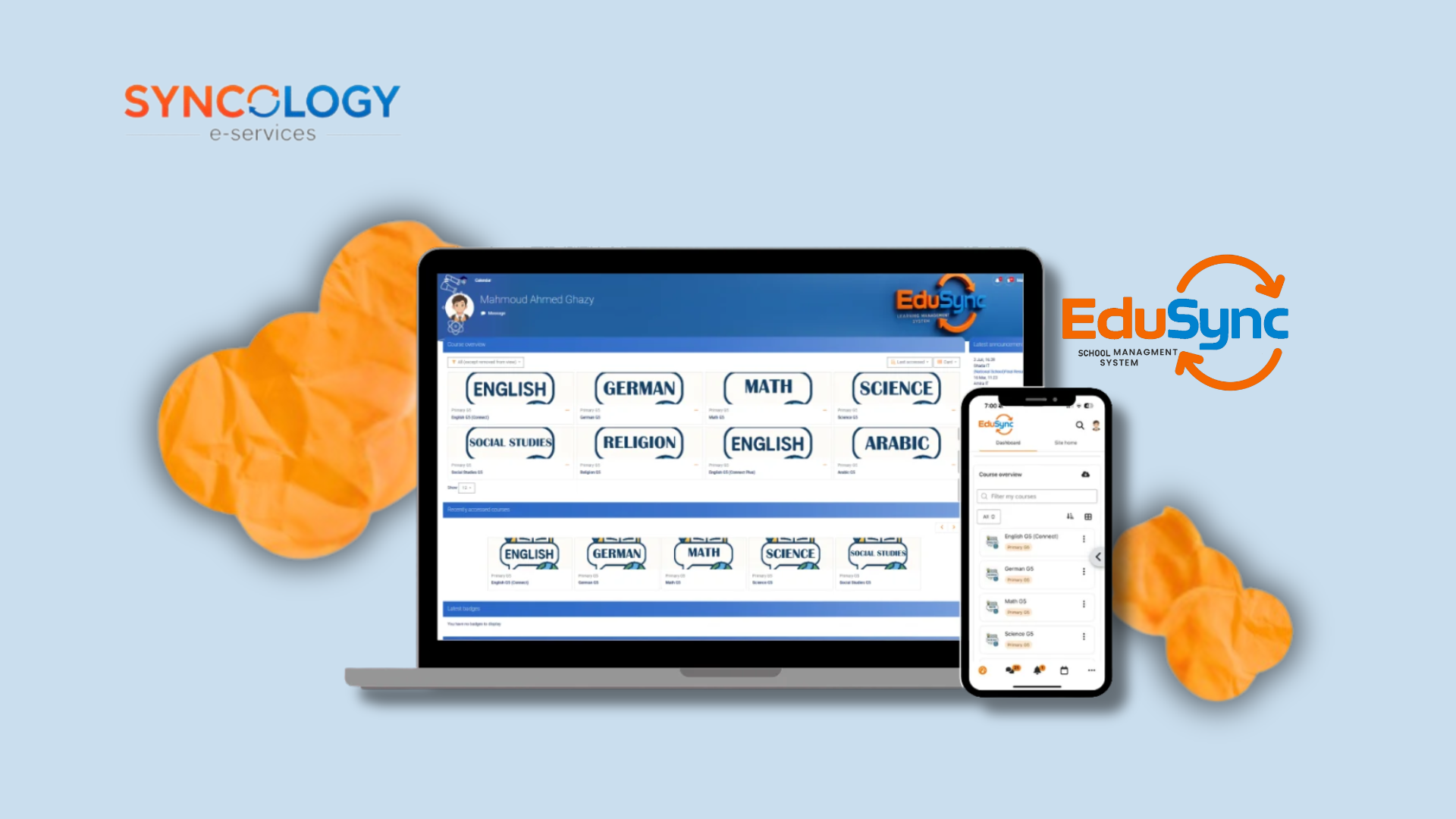
While the general benefits of an LMS are clear, selecting a system that truly leverages cutting-edge technology is essential. EduSync LMS from Syncology is specifically engineered to be the best online learning management system that enhances digital learning through intelligent automation and personalized student support.
EduSync LMS transcends conventional systems by integrating AI to serve all users:
- For Students: It provides personalized study plans, integrates interactive quizzes in multiple programming languages, and offers a built-in resume generator. Its real-time progress analytics are visualized through charts, enhancing self-awareness and motivation within a smart learning school environment.
- For Teachers: EduSync LMS acts as an AI-informed teaching assistant, significantly reducing the grading workload through automated evaluation and providing teachers with instant, actionable insights on student performance. This allows educators to dedicate more time to mentoring and fostering critical thinking.
- Integrated Efficiency: As an end-to-end school LMS software, EduSync LMS offers seamless one-click integration with major systems like SMS and Microsoft Teams, streamlining data synchronization and ensuring curriculum alignment. Furthermore, its advanced online exam maker features, complete with proctoring technology and shuffled question sets, ensure a secure and scalable assessment environment, solidifying its position as a top-tier LMS education system solution for achieving superior academic outcomes.
Click to Request an LMS Free Demo

Conclusion: Making the Learning Management System the Foundation for Future Success
The evidence is overwhelming: the Learning Management System is indispensable for modern education. To thrive, institutions must view their LMS for school not as a cost center, but as a vital investment in the academic future. The adoption of a robust, integrated, and intelligent platform transforms educational delivery, moving it from a fragmented, analog system to a centralized, efficient, and data-rich digital ecosystem.
By embracing features like personalized learning, automated administration, and real-time learning analytics, schools ensure they are providing the most engaging experience for students and the most productive environment for teachers.
Choosing the best LMS systems for schools, such as EduSync, guarantees that the institution is future-proofed, scalable, and fully prepared to navigate the evolving demands of online education management systems and smart learning school principles for the next decade. The successful deployment of an LMS is the clearest indicator of a school’s commitment to effective, engaging, and resilient digital learning outcomes.