


Implementing an effective school management system is now the foundational goal of any educational institution, and the core purpose of, is centred on academic achievement and student success. Yet, the energy and time of staff, from the front office to the finance department and academic leadership, are constantly diverted by a high hidden cost: inefficient manual administrative effort. This usually stems from relying on fragmented tools, performing excessive data entry, and struggling to track information across disconnected spreadsheets. This struggle represents a critical failure in operational efficiency.
This reliance on outdated, disjointed methods is precisely why modern schools are shifting their focus from simple applications to embracing a holistic education ERP solution. The question has evolved from “what is a school management system?” to “how does a fully integrated platform redefine the way we execute institutional tasks and support our students?”
A unified School management system transforms the operational paradigm. It fundamentally shifts the role of administrative staff from manual data processors to strategic contributors. This guide provides an in-depth look at how the cumulative effect of a unified school management software system drastically reduces the administrative burden across all departments. Our central thesis is that minimizing administrative effort through a modern school management system is the most crucial step toward maximizing resources and dedicating institutional focus to the core mission.
Reducing Effort in Student Lifecycle Management: The Core of the School Management System
The student journey from initial inquiry to full enrollment and daily attendance is often the largest source of manual overhead and paperwork. A robust School management system tackles this challenge by integrating the functions of the Student Information System (SIS) and automating key transitions.
Automating the Student Journey: Enrollment and Record Keeping Simplified by the School Management System
A. Admissions and Enrollment Automation
The initial process of enrollment and admissions is typically paper-heavy and time-consuming. A modern School management system eliminates this administrative effort by providing online, mobile-friendly application portals.
Instead of administrative staff processing paper forms and manually transcribing details, the system automatically validates applicant submissions, collects necessary documents, and centralizes all data directly into the core student management system ERP module. This process eliminates duplicate data entry and ensures the student’s record is clean, standardized, and accurate from Day One.
This foundational accuracy prevents cascading errors that would otherwise require significant manual cleanup in the financial and academic modules later on.
B. Timetable Scheduling and Conflict Management
Manual timetable creation is notoriously complex and is often one of the largest seasonal drains on administrative time. A powerful scheduling function within the School management system automates this complexity.
The system utilizes advanced algorithms to factor in all constraints: teacher availability, room capacity, subject requirements, and student academic pathways to generate conflict-free schedules in minutes. This automation replaces days or weeks of manual juggling. Furthermore, the platform is essential for effective school system management as it allows administrators to instantly manage and implement necessary changes, such as substitute teacher assignments or emergency room swaps, with minimal administrative effort, pushing updates instantly to all affected staff and student calendars.
C. Attendance, Reporting, and Record Keeping Efficiency
The administrative burden of daily attendance tracking is dramatically reduced when teachers log attendance digitally using the school management software mobile app or web portal. This simple digital entry triggers immediate automation:
- Daily attendance reports required for regulatory purposes are generated instantly.
- The system sends automated parental communication (via SMS or push notifications) for unexcused absences, eliminating the high volume of manual phone calls otherwise required of office staff.
- All student records: academic history, health information, and disciplinary notes are maintained in a single source of truth, accessible instantly via the centralized SMS dashboard. This consolidation saves countless hours previously spent searching for or reconciling information across physical files or siloed documents.
Minimizing Effort in Financial and Fee Management: School Accounting in the School Management System
The lack of integration between student data and financial ledgers is a major source of financial errors and administrative inefficiency. The solution lies in a unified School management system that tightly integrates the School Accounting module with the student data core.
Streamlining Revenue: How the School Management System Automates Fee Collection and Finance
A. Automated Invoicing and Billing Accuracy
In traditional, fragmented systems, the finance team must wait for manual enrollment reports before generating invoices. A modern ERP eliminates this bottleneck. The system automatically pulls real-time enrollment status, grade level, and specific fee structures from the SIS to generate accurate tuition invoices instantly.
This automation eliminates manual calculation errors and ensures the timely distribution of invoices, which is crucial for predictable cash flow and effective school system management. Any change in a student’s status (e.g., late withdrawal, financial aid adjustment) is instantly updated in the corresponding financial ledger.
B. Payment Processing and Reconciliation
The manual reconciliation of incoming tuition payments, matching bank deposits to individual student accounts, is one of the largest consumers of time for the School Accounting department. With a unified School management system:
- Automation: Integrated payment gateways allow parents to pay instantly online or via the parent portal.
- Efficiency: The system automatically matches and posts the payment to the correct student ledger and the general ledger in real-time. This reduces manual reconciliation time from days of complex cross-checking to mere minutes, freeing up the School Accounting staff for more strategic financial oversight.
The ultimate reduction in administrative effort comes from accessing comprehensive, reliable data instantly. Because financial and academic data reside in the same system, administrators gain immediate access to unified, cross-functional reports. Leadership can instantly pull a report correlating current tuition receivables with enrollment levels and projected operational costs. This shift to real-time analysis moves administration from reactive bookkeeping to proactive strategic financial management, a cornerstone of high-level school system management.
Automating Staff and HR Management: A Key Area of School Management System Efficiency
A comprehensive School management system extends its efficiency benefits to staff administration, an area often burdened by outdated manual HR processes that fail to integrate with the academic calendar.
From Payroll to Professional Development: Reducing HR Administrative Effort with the School Management System
A. Staff Records and Certification Tracking
Managing teaching certifications, mandatory training completion, and professional licensing expiration dates is a continuous, high-stakes administrative burden, particularly concerning compliance. A unified School management system module centralizes all staff profiles (qualifications, contracts, training history).
- Automation and Compliance: The system automatically tracks professional development credits and issues automated alerts well in advance of certification expiration dates. This proactive feature eliminates the tedious administrative effort involved in manually auditing compliance documents, significantly reducing the risk of regulatory penalties or lapses in credentialing.
B. Streamlined Leave Management and Payroll Integration
Leave requests are a significant source of paperwork and processing delay. The modern school management system simplifies this entirely:
- Teachers and staff submit leave requests digitally through the system’s dedicated portal.
- The request is automatically routed to the appropriate supervisor for approval.
- Once approved, the system instantly updates the master calendar for substitute teacher planning and, critically, transfers the leave data directly to the payroll module. This seamless automation eliminates the manual collection and processing of paper timesheets, reducing costly errors associated with calculating pay and dramatically boosting operational efficiency across the HR/Finance workflow.
C. Centralized Resource Management and Allocation
The administration of resources needed for staff, from managing office supplies to scheduling shared facilities, is centralized and tracked. The system manages internal requisitions and tracks the allocation of resources against specific departmental budgets, providing administrators with the tools necessary for cost-effective and efficient school system management.
Enhancing Communication, Grading, and Resource Management with the School Management System
The unified structure of the School management system profoundly improves the daily workflow of academic staff, enhancing both internal communication and the effective deployment of learning tools.
Boosting Operational Efficiency: Communication and Resource Tools in Your School Management System
A. Centralized and Targeted Communication
The headache of maintaining separate mailing lists for parents, staff, and students is eliminated. The school management system utilizes the integrated SMS data to facilitate instantaneous, targeted communication (via email, SMS, or app notification) based on precise criteria like grade level, specific classroom, or enrollment status. This highly targeted approach eliminates the administrative effort of manual list management and ensures critical information reaches the right audience immediately.
B. Academic Reporting and Gradebook Automation
The primary goal of a teacher is instruction, not paperwork. The digital gradebook feature allows teachers to input scores directly. Furthermore, the system is key to managing smart learning tools by providing a central point for assignment submission and grade collection. The school management system uses predefined templates to instantly auto-generate customized report cards at the end of the term, eliminating the massive administrative effort associated with manual data aggregation, formatting, printing, and distribution.
C. Technology and Asset Allocation
The system provides integrated asset tracking capabilities. Managing the inventory of smart learning tools, library books, lab equipment, or IT assets is consolidated within the school management system platform. This eliminates the need for separate tracking software, allowing administrators to audit resources quickly and accurately, thereby optimizing utilization and reducing the manual administrative effort required for physical inventory audits.
The Efficiency Advantage of EduSync School Management System (SMS)
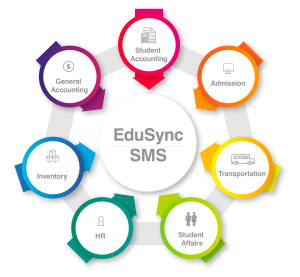
The full promise of a drastically reduced administrative workload is realized through dedicated platforms like EduSync SMS by Syncology. By integration with Odoo and Fawry, EduSync SMS is designed as a unified education ERP. Specifically excels at cutting administrative effort by enforcing a single, integrated architecture. It ensures that the Student Information System, School Accounting, and many more modules are one and the same, guaranteeing real-time data flow.
This design eliminates the need for complex, manual reconciliation and unnecessary data entry between platforms, thereby maximizing operational efficiency and allowing your team to focus its energy entirely on effective school system management and direct student engagement.
Conclusion: Reclaiming Time: The Core Strategic Benefit of Your School Management System
The cumulative impact of fragmented operations is a heavy tax on institutional resources and educational potential. By adopting a modern, unified School management system, institutions are making a strategic investment that directly translates to superior operational efficiency.
The result is a quantifiable, significant reduction in administrative workload, often ranging from 40% to 50%. Reducing administrative effort is not merely about cost-cutting; it is about reclaiming thousands of staff hours annually. These reclaimed hours allow skilled professionals to move away from mundane, repetitive tasks and focus on high-value, strategic initiatives: supporting at-risk students, developing advanced curricula, and driving the core educational mission. A modern, integrated education ERP solution is the essential foundation for transforming daily chaos into streamlined school system management and achieving sustainable institutional growth.