

The student accounting system is the primary engine for financial stability in any educational institution aspiring for growth and professionalism. It represents the ideal digital solution for managing all financial operations related to tuition fees and additional expenses. In the past, schools and universities relied entirely on paper ledgers or traditional “Excel” spreadsheets, which often led to data loss or overlapping accounts. Today, the implementation of an advanced student accounting system ensures 100% accuracy in tracking every penny that enters or leaves the institution’s treasury. Digital transformation in financial management is no longer a secondary option; it is an absolute necessity for international and private schools in Egypt and the Arab region to reduce human errors that cost institutions massive financial losses. Through a student accounting system, financial management can make decisions based on real numbers and immediate reports, which reflect positively on the quality of educational service and the stability of resources available for facility development.
Why Do Schools Need a Student Accounting System?
Modern educational institutions face complex challenges in managing tuition fees, especially with the increase in student numbers and the diversity of expense items, ranging from tuition fees, books, and buses to extracurricular activities. This is where the urgent need for a student accounting system arises to address the chaos resulting from manual management. The biggest challenge lies in “accounting errors”; a simple mistake in entering the payment data for a single student could lead to a dispute with a parent or a deficit in the final budget.
Furthermore, schools without a student accounting system suffer from extreme difficulty in following up on arrears. This requires manually reviewing hundreds of records to identify who has paid and who hasn’t. This slowness hampers the cash flows necessary to pay staff salaries and cover operational costs. Therefore, the importance of digital transformation lies in the ability to automate these processes, whereby the student accounting system sends automatic alerts, issues instant receipts, and provides a centralized database that prevents the loss of any financial information, no matter how small.
What is a Student Accounting System? Definition and Vital Role
A student accounting system can be defined as a specialized software platform aimed at automating and digitizing all financial transactions between the student and the educational institution. This system differs from general accounting programs (such as QuickBooks or general SAP) in that it is specifically designed to understand the complex “tuition fee” structure, which includes discounts, grants, installments, and variable fees based on the educational stage.
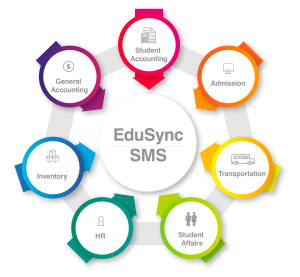
The student accounting system is closely linked to the comprehensive School Management System (SMS), as it pulls academic student data to generate financial claims based on it. The entities that primarily need this system include:
- Schools (of all types): To regulate the collection of annual fees.
- Universities: To manage the accounts of thousands of students and credit hours.
- Training Centers: To organize fees for short courses and workshops.
- Educational Academies: To track monthly or quarterly student subscriptions.
Simply put, a student accounting system is the technical link that transforms the financial process from an “administrative burden” into a “competitive advantage” that increases parents’ confidence in the institution.
How Does a Student Accounting System Work? The Digital Financial Cycle
A student accounting system operates according to a logical sequence that ensures accuracy at every stage, starting from the moment a student is accepted into the institution:
First: Registering Financial Data and Allocating Fees
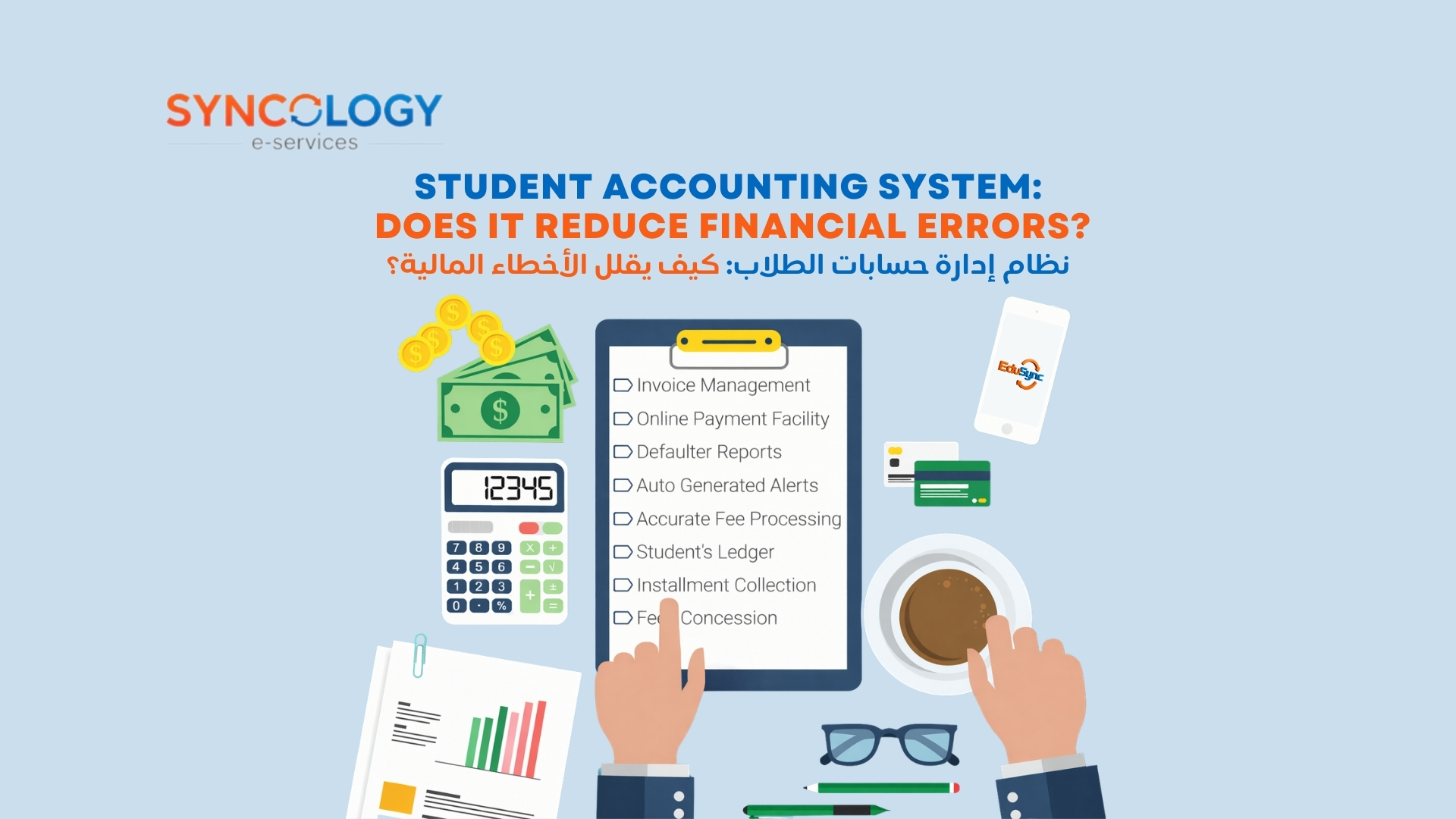
As soon as the student’s data is entered into the system, it is linked to the fee package specific to their educational stage. The student accounting system automatically distributes fees (registration fees, first installment, book fees, etc.) based on pre-defined regulations.
Second: Invoice Management and Automatic Scheduling
Instead of writing invoices manually, the student accounting system issues invoices automatically and sends them to the parents’ email or via a mobile app. The system also allows for “payment scheduling,” where the total amount is divided into installments with precisely defined due dates.
Third: Registering Payments and Multiple Methods
A student accounting system supports all modern payment methods:
- Cash Payment: With an instantly printed receipt.
- Bank Transfer: With the ability to attach a copy of the transfer for review.
- Electronic Payment: Integration with payment gateways (such as Fawry, Visa, MasterCard) to update the payment status in real-time.
Fourth: Tracking Arrears and Reports
If an installment date arrives and payment has not been made, the student accounting system automatically includes the student in the “arrears list” and sends an alert to the parent. At the end of the day, the system issues detailed financial reports showing the collected and expected revenues.
Top Features of a Student Accounting System in Modern Institutions
The role of a student accounting system is not limited to being just a digital calculator; it is an integrated system that grants financial management power and control through exceptional features:
- Extremely Flexible Tuition Fee Management: The system allows the school to define a complex fee structure that changes based on the educational stage, academic year, or even the type of curriculum (National or International). The student accounting system also facilitates the application of various discount policies, such as the “sibling discount” calculated automatically once students are linked to a single parent, or academic and athletic scholarships. This ensures the application of regulations without any human intervention that might result in calculation errors.
- Stunning Real-time Payment Tracking: The system provides a historical record for each student (Statement of Account), showing every invoice issued and every amount paid, with a clear balance remaining at any moment. This feature in the student accounting system prevents any confusion that may occur when reviewing accounts with parents, as every receipt is documented with time, date, and payment method.
- Automated Issuance of Comprehensive Financial Reports: With the click of a button, the financial manager can obtain cash flow reports and expected budget reports based on scheduled installments. The student accounting system is also distinguished by its ability to extract “debtor balance” reports that accurately clarify the overdue amounts for each classroom, facilitating the collection process.
- Software Integration with the Parent Portal: The system provides a direct financial communication channel; parents can log into their private accounts through the student accounting system to see all dues, download digital copies of invoices, and even pay online without needing to visit the school premises. This enhances the efficiency of the collection process and saves everyone’s time.
Major Challenges in Student Account Management Without a Digital System
Schools that do not use a student accounting system are drowning in a series of problems that could threaten their stability:
- Loss of Data and Files: Paper records are prone to damage or loss. Losing a single “security voucher” could mean losing a financial right for the school or the student.
- Difficulty Tracking Partial Payments: When a parent pays small, scattered amounts, it is difficult for a manual accountant to set the remaining balance accurately. In contrast, a student accounting system calculates the remainder automatically after every transaction.
- Account Errors and Manipulation: The absence of digital oversight may open the door to unintended errors or even financial manipulation. This is completely closed by a student accounting system through activity logs.
- Wasted Time: Consuming long hours writing receipts manually and emptying them into ledgers is time that could be utilized for more productive tasks when using a student accounting system.
- Difficulty Extracting Reports for Regulatory Bodies: When a sudden financial report is requested by the Ministry or an accreditation body, traditional schools struggle, while the system provides the report in seconds.
Difference Between Traditional Management and a Digital Student Accounting System
The following table illustrates why moving to a digital system is a winning investment by all measures:
| Comparison Point | Traditional Management (Manual/Excel) | Digital Student Accounting System |
| Registration Method | Slow and error-prone manual recording | Instant and accurate electronic recording |
| Data Accuracy | High probability of accounting errors | Extreme accuracy thanks to automated calculations |
| Financial Reports | Difficult to extract and takes days | Instant reports and smart dashboards |
| Arrears Tracking | Exhausting manual review | Automatic alerts and real-time tracking |
| Execution Time | Long hours consumed in manual operations | Significant time savings and increased productivity |
| Parent Experience | The necessity of attending school for payment | Electronic payment and inquiry from anywhere |
Essential Characteristics of a Professional Student Accounting System
When searching for the right student accounting system, you must ensure these basic characteristics are available to ensure maximum benefit:
- Ease of Use: The system must have a simple interface that enables financial staff to complete tasks without technical complexities, reducing training time.
- Automatic Invoice Management: The most important feature is the ability of the student accounting system to generate invoices periodically based on the payment plan agreed upon with the student.
- Advanced Financial Reports: The system does not just add and subtract; it must provide analytical reports (such as cash flow forecasts) to help management make proactive decisions.
- Integration with School Systems: The student accounting system must “talk” to the Human Resources (HR) system to link expenses to salaries and to the Learning Management System (LMS) to control permissions.
- Security and Data Protection: Given the sensitivity of financial data, the system must provide strong encryption and a precise permission management system, ensuring data is viewed only by authorized personnel.
How to Choose the Best Student Accounting System for Your School?
Choosing a student accounting system is a strategic decision that spans years, so the following must be considered:
- Accurately Identify School Needs: Do you need a system that supports multiple currencies? Do you need to link more than one branch? The system must be flexible enough.
- Number of Students and Payment Methods: Ensure the student accounting system accommodates your current and future student numbers and supports payment methods preferred by parents in your region.
- Scalability: Educational institutions grow; therefore, the system must grow with you and not force you to change after just one year.
- Technical Support: It is important to choose a company that provides strong technical support and continuous training to ensure work in the student accounting system continues without interruption.
- Cost vs. Value: Do not look for the cheapest; look for the system that will save you massive amounts by preventing financial errors and improving collection.
How Does the System Help Improve Financial Management?
A student accounting system represents the cornerstone of transforming financial management from traditional “reactive” management to proactive smart management through:
- Absolute Transparency: The system reduces opportunities for manipulation or financial conflict; every data entry process in the student accounting system leaves a digital audit trail showing who operated and when. This level of transparency protects employees and management and builds bridges of trust with regulatory bodies and parents.
- Improving Cash Flows and Collection: Through the automatic scheduling feature, the student accounting system monitors due dates in real-time. When an installment date approaches or is delayed, the system sends automatic reminder messages, motivating parents to pay on time, thus ensuring the school has the liquidity needed to cover its obligations.
- Facilitating Financial Planning and Estimated Budgets: Thanks to the big data collected by the student accounting system, it becomes easy for senior management to develop expansion plans for the coming year. The system precisely clarifies the actual vs. targeted collection percentage and analyzes revenues from different sources (buses, books, tuition), making financial planning based on solid facts rather than just expectations.
- Improving Parent Experience and Institutional Reputation: When a parent finds an accurate system that does not make mistakes in its calculations and provides easy electronic payment methods, their impression of the school improves significantly. The student accounting system is the school’s financial interface that reflects its level of development and professionalism.
The Student Accounting System from Syncology
Syncology is a leader in providing software solutions for the educational sector, and the student accounting system stands out as one of the fundamental pillars of the “EduSync” platform. We designed this system to be the “Smart Financial Assistant” every school principal and accountant needs to avoid daily financial headaches.
What makes the student accounting system from Syncology the first choice?
- Full Customizability: We realize that every school has a unique nature; therefore, our system allows you to build your own fee structure no matter how complex, with full support for VAT and multiple currencies for international schools.
- Data Security and Privacy: In our student accounting system, we use global encryption protocols to protect financial data, with a precise permission system ensuring sensitive financial details are only viewed by authorized personnel.
- Technical Support and Continuous Development: Our role does not end with installing the system; we provide intensive training for your financial team to ensure the utilization of all student accounting system capabilities, along with periodic updates aligned with changing financial and tax laws.
- Ease of Integration: The student accounting system from Syncology can work independently or integrate seamlessly with bank systems and electronic payment gateways, as well as student affairs and attendance systems, to create an integrated digital environment for your institution.
With Syncology, you ensure that the student accounting system will perform all the heavy lifting with extreme accuracy, giving you the time to focus on your ultimate mission: developing the quality of education.
Conclusion: The Future of Digital Financial Management in Education
In the end, it cannot be denied that a student accounting system is the backbone of any financial success within educational institutions. Accuracy, transparency, and speed are the keys to successful management in 2026 and beyond. Investing in a digital system is not just keeping up with technology; it is securing school resources and protecting the rights of both students and management.
By using a student accounting system, you will discover that many of the burdens that used to plague the accounting department have completely disappeared, opening new horizons for growth and institutional excellence. Digital transformation starts with a step, and the best step you can take today is digitizing your accounts to ensure a stable financial future.
Are you ready to digitize your school’s accounts and eliminate financial errors?
- Request a Free Demo: To experience the student accounting system from Syncology in practice.
- Consult Our Experts: To obtain financial and technical consultation aimed at developing your school.
- Start Now: And join the elite educational institutions that chose digital excellence with Syncology.