
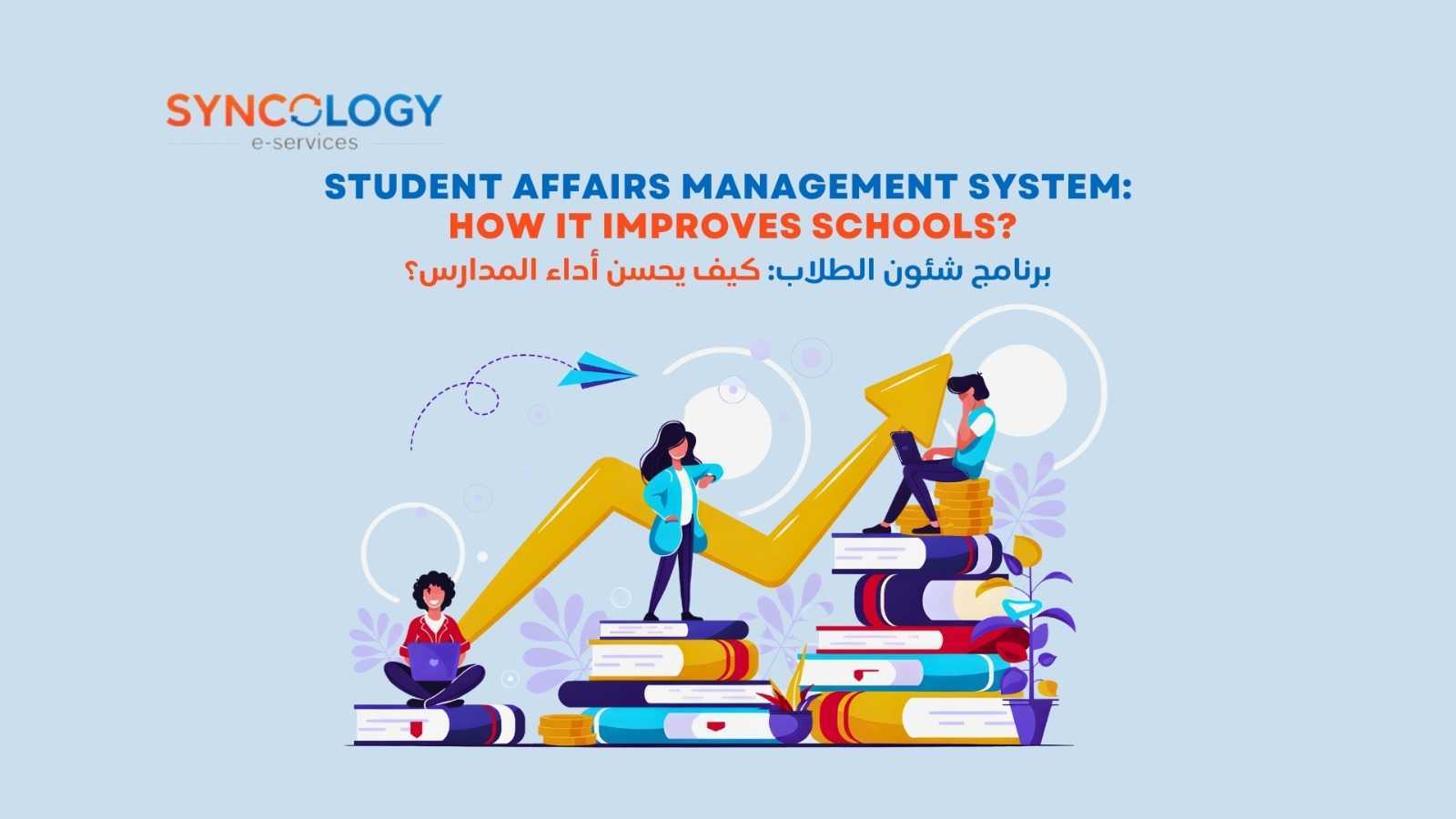

The Student Affairs Management System is the cornerstone upon which the administrative and educational process rests in any educational institution striving for excellence. In an era where digital transformation in education dominates all sectors, it is no longer acceptable to rely on traditional methods that have exhausted the energy of administrators for many years. A Student Affairs Management System is not merely a data repository; rather, it is the intelligent engine that connects the student to the school, the teacher to the curriculum, and the administration to the results.
Why Do Schools Need a Student Affairs Management System?
Schools today face increasing challenges resulting from the growth in student numbers and the complexity of administrative operations associated with them. Managing hundreds or thousands of students is no longer a simple task that can be confined to paper ledgers or even scattered “Excel” files. The problems of manual management lie in the possibility of catastrophic errors in recording grades, or the loss of historical student data, in addition to the extreme difficulty in tracking academic performance, attendance, and departure in real-time.
From this standpoint, there has emerged an urgent need for school management software that places student affairs at the top of its priorities. Digital transformation in education has imposed a new reality that requires speed, accuracy, and transparency. Schools that adopt an advanced Student Affairs Management System do not only automate tasks; they build an intelligent educational environment that ensures every student receives their academic and educational rights without any administrative failure. A Student Affairs Management System is no longer just a supporting tool; it has become an essential part of the success of any modern school aspiring for leadership.
What is a Student Affairs Management System?
A Student Affairs Management System can be defined as an integrated technical platform aimed at digitizing the entire student life cycle within the school, starting from the submission of an admission application all the way to graduation and the issuance of certificates. This software plays a pivotal role in managing all aspects related to the student, including personal data, academic records, daily attendance and absence tracking, student distribution into classes, and the monitoring of results and periodic reports.
The Student Affairs Management System is organically linked to the comprehensive school management system, where it is considered the primary module that feeds other departments with data. It is also closely related to the learning management system (LMS); while the student affairs system manages the administrative side and basic data, the LMS handles the academic side and educational interaction. The difference between it and traditional systems is vast; modern systems provide a “unified database” that prevents data duplication and ensures administrative access to information in seconds from anywhere.
Components of a Student Affairs Management System within a School Management System
This section is the most important when searching for the best ERP for schools, as the system must include the following components:
- Student Data Management (Student Profiles): This includes creating a comprehensive digital file for each student that encompasses personal data, document images, health records, and family data. This file is the primary and final reference for every department in the school.
- Classroom and Schedule Management: The school management software allows for the intelligent distribution of students into classes based on numerical density or specific criteria, while organizing class schedules and preventing timing conflicts between teachers and halls.
- Attendance and Absence Management: The Student Affairs Management System provides mechanisms for recording daily attendance, whether manually by the teacher via a mobile application or automatically through biometric devices, with the issuance of immediate absence reports and automated alerts for parents.
- Grades and Assessment Management: This is the beating heart of the academic process, as it allows for recording test results, calculating averages, and issuing certificates of appreciation and detailed performance reports that clarify the student’s strengths and weaknesses.
- Reports and Analytics: The ideal school management system provides a statistical dashboard for the administration that shows student numbers, success and failure rates, and absence rates, which helps in evaluating the quality of education in the school as a whole.
Challenges Facing Schools Without a Student Affairs Management System
A school operating without an advanced Student Affairs Management System faces direct confrontation with “administrative chaos” that drains human and financial resources. The first of these challenges is data fragmentation and the loss of knowledge assets; in a traditional system, student information is scattered between paper attendance registers, manual grade sheets, and separate accounting files. This fragmentation makes it impossible for the administration to obtain a “unified vision” (Single Source of Truth) of the student’s status, leading to decisions based on incomplete or outdated information.
Furthermore, there is the challenge of fatal slowness in routine operations; without digital school management, extracting a certificate of enrollment or a grade statement requires reviewing dozens of records manually, which consumes work hours that would have been better directed toward developing the educational process. Moreover, “human errors” in manual management are a ticking time bomb; a simple error in recording a test grade or an absence date could lead to legal and administrative problems with parents or educational accreditation bodies, a risk that vanishes completely when using digital school management software.
In addition, there is the challenge of weak oversight and security; paper records are vulnerable to damage, fire, or even unauthorized tampering. Meanwhile, the best ERP for schools provides encryption security levels that ensure every modification in student data is recorded with the employee’s name and the date of the action. Finally, traditional schools suffer from “parental isolation,” as parents find no immediate way to follow up on their children, creating a communication gap that weakens community trust in the school’s efficiency, a gap that can only be bridged by digital transformation in education.
How Does a Student Affairs Management System Improve School Management Efficiency?
The contribution of a Student Affairs Management System to improving efficiency is a “smart restructuring” of every aspect of the work. First, by automating the student life cycle, tasks shift from “exhausting manual labor” to “intelligent supervision”; admission and registration processes that once required an army of employees now become a fully digital process starting with a button click from the parent via the internet, raising operational efficiency by rates exceeding 80%.
Secondly, the school management software contributes to improving academic follow-up; it allows teachers and administration to monitor the “performance curve” of each student cumulatively over their years of study. This type of analysis allows for early intervention to treat cases of academic stumbling or to support gifted students, thereby raising the final educational quality of the school. Thirdly, the system plays a crucial role in improving institutional communication; by sending immediate notifications via mobile applications regarding absences, results, or even bus schedules via the transportation management system, the parent feels like a true partner in the educational process.
Fourthly, the system enhances the accuracy of strategic planning; instead of guessing, the administration now possesses accurate statistical reports regarding student densities in each class and achievement rates in each subject, which helps in distributing teachers and resources optimally. Fifthly, the value of an integrated accounting system with student affairs emerges in ensuring cash flows; student financial records are linked to electronic payment mechanisms, which reduces delinquency rates and facilitates financial collection operations with the click of a button.
The Role of a Student Affairs Management System in a School Management System
In any ERP for schools, the student affairs module is seen as the “nucleus” around which all other modules revolve. Its role goes beyond mere organization to reach a stage of “organic linking” that prevents data conflict. For example, this program is linked to the school’s human resources management system by determining the “teaching load”; when the system records an increase in student numbers for a certain stage, it automatically alerts the HR department of the need to provide additional teachers or open new classes based on the programmed schedules.
The Student Affairs Management System also plays the role of a financial mediator; it feeds the accounting system with all the data necessary to issue financial claims, whether they are tuition fees, transportation fees, or even the costs of school uniforms recorded in the inventory management system. This integration ensures that no financial information is lost and achieves strict oversight over the budget.
In addition, integration with the learning management system (LMS) represents the pinnacle of development in digital school administration; as soon as a student is assigned to a classroom within the Student Affairs Management System, their access to the digital content designated for that class in the LMS is automatically activated. This digital link creates a “paperless” environment, where information flows smoothly from the admission department to the classroom to the accounts, making the ideal school management system a reality that serves the institution’s goals and stakeholders’ aspirations.
The Relationship Between Student Affairs Management Systems and Learning Management Systems (LMS)
This point is the core of digital education management. Integration between the Student Affairs Management System and the learning management system (LMS) means that as soon as a student is administratively accepted, an account is automatically created for them on the learning platform. Data on classes, schedules, and subjects move from student affairs to the LMS so that the student can begin their journey in downloading content, performing assignments, and participating in electronic tests.
This relationship improves the learning experience amazingly; grades from electronic tests in the LMS are monitored and automatically sent to the Student Affairs Management System to appear in the student’s final certificate. The equation is simple: Student Affairs Management System + LMS = an integrated educational system that ensures the link between the administrative and academic sides without human intervention hindering the process.
The Difference Between Traditional Management and a Student Affairs Management System
| Comparison Aspect | Traditional Management (Paper-based) | Student Affairs Management System (Digital) |
| Data Storage | Paper files and a massive physical archive | Secure, easy-to-access cloud-based digital system |
| Information Accuracy | Vulnerable to human errors and forgetfulness | Very high accuracy thanks to automated calculations |
| Access Speed | Takes a long time for manual searching | Fast and instantaneous access to information |
| Reporting | Exhausting and inaccurate manual reports | Instant, interactive reports supported by statistics |
| Time and Effort | Significant consumption of time and human resources | Massive savings in time, effort, and costs |
Most Important Features That Must Be Available in a Student Affairs Management System
When searching for the best ERP for schools, your evaluation must go beyond mere appearances to focus on the core functions that ensure work sustainability:
- First, High Flexibility in Customization: A professional system must adapt to your school’s internal regulations and its specific grading system, not the other way around.
- Second, Integration Capability: A system that works in isolation from accounting or the LMS is a deficient system that increases the complexity of the work rather than simplifying it.
- Third, Power of Reports and Artificial Intelligence: The system must provide “predictive” reports that do not just monitor the past but help in predicting the future of student performance or cash flow.
- Fourth, Ease of User Experience (UX): The system will be handled by employees, teachers, and parents with varying technical levels, so the interface must be simple, intuitive, and support both Arabic and English fluently.
- Fifth, Security and Cloud Backup: The system must ensure the protection of student data from hacking while providing periodic backup that ensures no information is lost under any circumstances.
- Sixth, Multi-platform Support: In our current era, the system must be available as school management software via the web, and also as dedicated applications for Android and iPhone to ensure real-time communication anytime and from anywhere.
Student Affairs Management System from EduSync (Syncology)
Syncology offers, through its leading system EduSync, the ideal and complete solution for school management. The Student Affairs Management System in EduSync is considered an inherent and integral part of an integrated work environment that combines power and ease. What distinguishes Syncology’s solutions is their construction on global technologies such as Odoo for financial management and Moodle for learning management, with full integration with Microsoft tools.
Features of the Student Affairs System from Syncology:
- Comprehensive Management: Covers all student stages from electronic admission until graduation.
- Smart Integration: The system automatically links with the accounting system, the learning management system (LMS), and the school inventory management system.
- Extreme Flexibility: Student affairs can be used as part of the complete system or as a separate module according to the school’s needs.
- Reporting Accuracy: Provides detailed reports on student absences, their evaluations, and their distribution in school buses via the transportation management system.
In short, EduSync is the ideal school management system that gives owners and managers peace of mind and absolute control.
How to Choose the Best Student Affairs Management System for Your School?
Choosing the ideal school management system is a strategic decision that extends for years, so the process must begin with a precise analysis of needs; does your school need a greater focus on the financial side? Or on tracking transportation? Or on e-learning? Setting priorities is the first step. Secondly, the reputation of the developer and technical support must be evaluated; technical systems always need updates and continuous support, and a company like Syncology stands out here thanks to its track record of success with major schools and its experience in providing 24/7 support.
Thirdly, look for Scalability; the system you request today for a school of 500 students must be capable of managing 5,000 students tomorrow without needing to change the infrastructure. Fourthly, the Total Cost of Ownership (TCO); do not only look at the purchase price, but calculate the costs of training, updates, and technical support, and ensure that the added value provided by the system from reducing waste and increasing efficiency far outweighs its financial cost. Finally, always request a Demo and involve the student affairs team and teachers in evaluating it; they are the actual users who will determine the system’s success in your daily school reality.
The Future of Student Affairs Management Systems in Education
The future of digital school management is moving toward “Artificial Intelligence.” We will soon see a Student Affairs Management System capable of analyzing student behavior and predicting academic stumbling before it happens (predictive analytics). Integration will also develop to make learning fully “autonomous,” where the system allocates class schedules and materials based on the learning speed of each student individually.
Full automation is the next goal, where routine administrative tasks will disappear completely, turning the student affairs employee into a “data analyst” and “quality monitor,” which raises the educational value of the school and makes it keep pace with the highest international standards in smart education.
Conclusion
In conclusion, it appears to us that the Student Affairs Management System is not just a technical program, but an administrative vision aimed at raising the status of the educational institution. Investing in advanced school management software is an investment in the success of students, the comfort of administration, and the trust of parents. The role of technology in improving administrative performance is no longer open to discussion, and digital transformation is the only way to stay in the circle of competition.
Start your journey of excellence now! Do not leave your school’s management to chance or to exhausting paper systems. Contact the Syncology team today and request a free Demo of the EduSync system, and discover how we can help you achieve digital transformation in education with the highest efficiency and the least effort.