
School Management System in Saudi Arabia platforms have become one of the most important investments for private and international schools seeking operational excellence, regulatory compliance, and long-term digital transformation. As the Kingdom accelerates its national vision to build a world-class, technology-driven knowledge economy, educational institutions face mounting pressures. School leaders are no longer managing simple physical campuses; they are steering complex, multi-faceted enterprises that must balance rigorous academic standards with sophisticated administrative, financial, and logistical demands.
Choosing the right School Management System in Saudi Arabia requires a strategic mindset that extends beyond surface-level feature checklists. Historically, many educational institutions relied on fragmented software tools—using one application for gradebooks, a separate spreadsheet for tuition tracking, an offline biometric reader for staff attendance, and manual paper forms for student admissions. This disconnected approach creates operational friction, increases human error, causes data silos, and frustrates parents who expect immediate, mobile-first communication through their chosen School Management System in Saudi Arabia.
This comprehensive buyer’s guide serves as an authoritative procurement framework for school owners, board members, principals, IT directors, and digital transformation leaders. By exploring the Saudi educational technology ecosystem, evaluation criteria, regulatory considerations, deployment models, and integration capabilities, this guide helps institutions select a School Management System in Saudi Arabia that drives sustainable operational growth and academic success.
Understanding the Need for a School Management System in Saudi Arabia Market in 2026
Evaluating a School Management System in Saudi Arabia in 2026 requires understanding a rapidly maturing educational technology landscape. Driven by massive national investments in digital infrastructure, the Saudi K-12 education sector—particularly across private, international, and charter school groups—has undergone a structural evolution. Digital education is no longer viewed as an emergency backup for remote learning; it has become the fundamental operational infrastructure of modern schooling.
Several key shifts define the current market environment:
- Accelerated Private & International School Expansion: The growth of private and international school networks across major urban centers like Riyadh, Jeddah, and Dammam has heightened market competition. Schools must differentiate themselves not only through academic curricula, but also through administrative efficiency, modern parent communication tools, and smooth digital onboarding facilitated by a modern School Management System in Saudi Arabia.
- Widespread Cloud Adoption: On-premise servers tucked away in physical IT closets are rapidly being replaced by secure, scalable cloud architecture. Cloud deployment eliminates the burden of local server maintenance, reduces hardware depreciation, and guarantees high availability during critical periods like final exam grading or annual tuition registration.
- Artificial Intelligence in Education: Modern platforms are moving from passive record-keeping to active operational intelligence. AI-assisted tools help academic directors detect student learning gaps early, optimize master timetables, automate routine administrative workflows, and deliver personalized progress reports to families.
- Evolving Parent Expectations: Today’s parents belong to a tech-savvy generation. They expect a unified mobile experience that lets them pay tuition fees with one tap, review daily attendance, track school buses in real time, communicate with teachers, and sign digital permission slips—all from a single, intuitive interface powered by an advanced School Management System in Saudi Arabia.
For school decision-makers, these shifts mean that a standalone School Management System in Saudi Arabia is no longer sufficient on its own. Institutions require an integrated education ecosystem that unifies Student Information Systems (SIS), Learning Management Systems (LMS), and Enterprise Resource Planning (ERP) into a single operational core.
Key Requirements for SMS in Saudi Arabian Schools
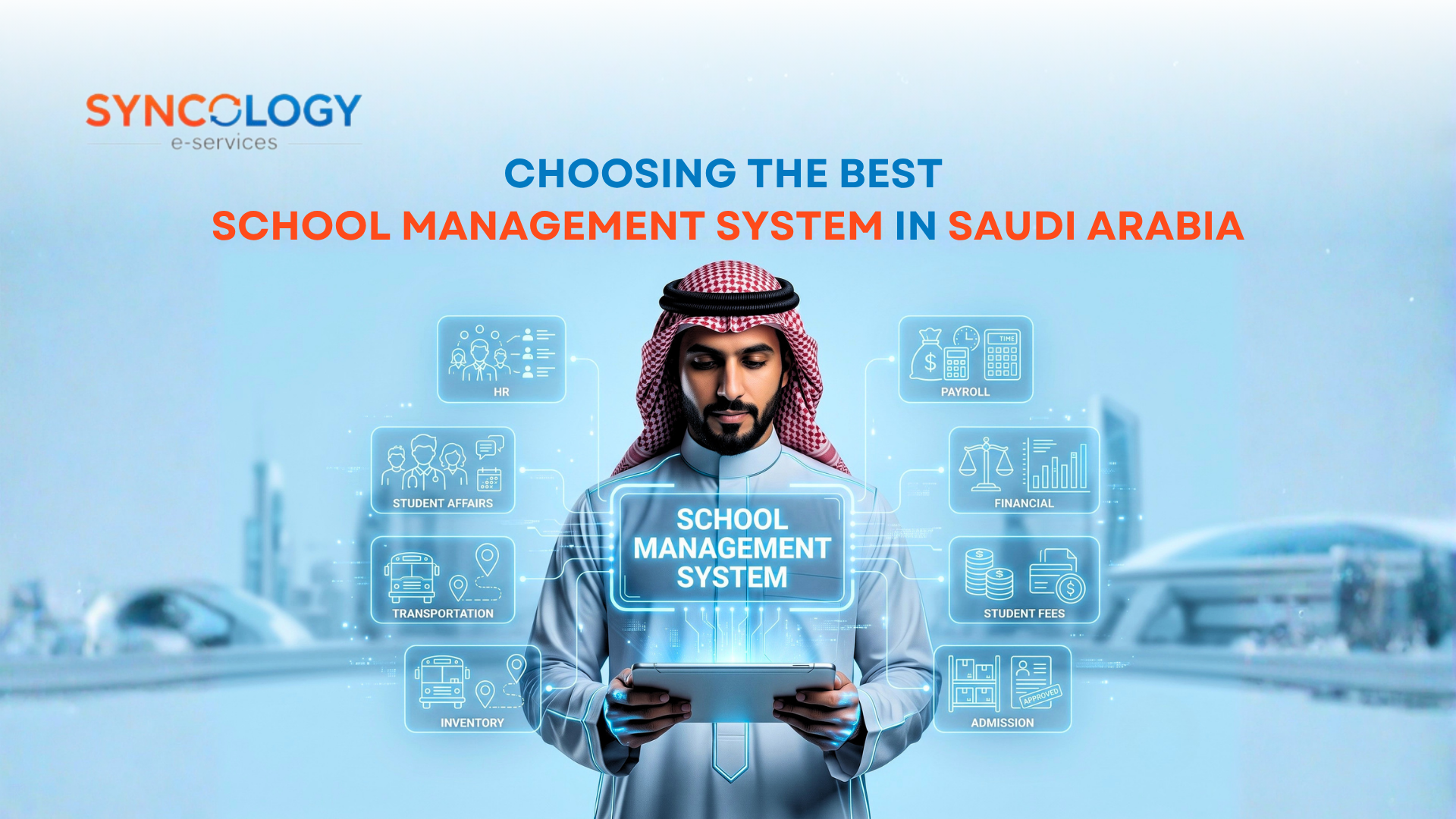
Selecting a robust School Management System in Saudi Arabia requires a thorough assessment of an institution’s operational requirements. A platform must support every stage of the student and administrative lifecycle, ensuring data flows smoothly across departments without manual re-entry.
1. Student Information Management (SIS)
The SIS module forms the primary database of the entire school. It maintains lifelong student records, emergency medical contacts, historical academic transcripts, disciplinary logs, and family linkages. It must support complex academic structures, including multi-term calendars, GPA calculations, weighted credit systems, and custom grading rubrics for British, American, IB, and National curricula.
2. Streamlined Admissions & Enrollment Pipeline
A modern platform acting as your primary School Management System in Saudi Arabia must digitize the entire student intake journey:
- Custom online application portals for prospective parents.
- Automated document collection (national IDs, birth certificates, previous school records).
- Scheduling and tracking for student entrance interviews and assessment exams.
- Automated seat allocation, application fee processing, and conversion of approved applicants into active student records.
3. Attendance & Timetable Management
Accurate attendance tracking is both an operational necessity and a safety requirement. Systems should support automated daily attendance via biometric devices, RFID gate scanners, or mobile teacher apps. Master timetable generators must cross-reference room availability, teacher workloads, course electives, and split-class configurations to automatically build conflict-free schedules.
4. Human Resources & Localized Payroll
School HR operations differ significantly from standard corporate environments. The HR module must handle teacher contracts, substitute teacher tracking, professional development records, leave management, and complex monthly payroll processing that accounts for allowances, GOSI contributions, end-of-service benefits (EOSB), and summer pay distribution models.
5. Integrated Financial Management & Invoicing
The financial engine must manage complex tuition structures, sibling discounts, scholarship adjustments, track installment schedules, issue compliant e-invoices, process electronic refunds, and maintain general financial ledgers without requiring external accounting software.
6. Parent Portal & Mobile Apps
Dedicated iOS and Android mobile applications for parents, teachers, and students increase engagement. Real-time push notifications ensure that urgent announcements, attendance alerts, exam schedules, and fee reminders reach families instantly.
7. Role-Based Permissions & Multi-Campus Architecture
For growing education groups operating multiple branches across Saudi Arabia, the system must offer native multi-campus architecture. Executive leadership requires consolidated cross-branch reporting, while granular role-based permissions ensure that teachers, accountants, and campus administrators access only the data relevant to their assigned roles.
Arabic Language Support & RTL Interface
In the Saudi educational landscape, localization is far more than a simple cosmetic feature or a word-for-word machine translation. A platform built for a School Management System in Saudi Arabia must feature native, right-to-left (RTL) Arabic architecture designed from the ground up to support regional administrative workflows.
Why Native Localization Matters
- User Adoption Across All Stakeholders: While international teaching staff may operate primarily in English, administrative personnel, Arabic language educators, government liaisons, and many parents interact exclusively in Arabic. A system with a clunky, poorly translated Arabic interface creates user friction, increases data entry errors, and reduces adoption.
- Dynamic Language Switching: Users should be able to toggle instantly between full Arabic and English interfaces without losing their context, breaking page layouts, or corrupting dual-language data fields.
- Dual-Language Document Generation: Official school documents—including academic transcripts, student attendance warnings, report cards, tuition receipts, and behavioral notices—must be generated automatically in polished, dual-language PDF formats suitable for official submission and parent distribution.
- Localized Parent Communication: Automated push notifications, SMS alerts, and email announcements must deliver correctly formatted Arabic text directly to parents’ mobile devices, ensuring clear and professional school-home communication.
MOE Compliance & Data Residency Requirements
Deploying any School Management System in Saudi Arabia involves strict regulatory responsibility. Educational institutions handle sensitive personal, academic, and financial data belonging to minors and families. Consequently, school decision-makers must prioritize regulatory compliance, data privacy, and secure governance frameworks when evaluating software vendors.
Key compliance considerations include:
- Data Sovereignty & In-Kingdom Hosting: Educational data regulations generally mandate that primary databases containing Saudi student records, financial transactions, and institutional logs reside within certified cloud infrastructure located inside the Kingdom of Saudi Arabia.
- Granular Data Privacy Controls: Systems must provide strict access permission matrices (access control). Users should access only the minimum necessary data required to perform their daily duties, protecting sensitive medical records, counselor notes, and family financial statuses.
- Audit Trails & Security Logging: To ensure transparency and prevent data tampering, the platform must maintain comprehensive audit logs (Audit Logs). Every system action—including grade edits, attendance modifications, fee adjustments, and record deletions—must log the responsible user, exact timestamp, and IP address.
- Secure Authentication Frameworks: Implementing Multi-Factor Authentication (MFA) and Single Sign-On (SSO) integrations helps protect administrative accounts from unauthorized access and credential theft.
⚠️ Compliance Note:
School administrators should verify that software providers adhere to applicable Saudi data governance frameworks and Ministry requirements. Institutions should consult their legal counsel and compliance officers when finalizing software procurement agreements.
Integration with Saudi Payment Gateways
Financial management is one of the most operationally demanding aspects of running a school. An effective School Management System in Saudi Arabia must include a financial engine that integrates smoothly with local digital payment networks to simplify tuition collection and automated bank reconciliation.
Benefits of Local Payment Integrations
- Parent Convenience: Providing parents with familiar, instant digital payment options directly inside the school mobile app removes the need for physical bank transfers, manual receipt uploads, or standing in long queues at the school accounting office.
- Instant Payment Reconciliation: Traditional manual bank transfers require accounting staff to match bank statements against student invoice numbers manually—a process prone to errors and delays. Integrated payment gateways automatically reconcile settled payments against student ledgers, update tuition statuses instantly, and issue digital receipts.
- Structured Installment Plans: Schools can set up automated recurring billing schedules, automatically applying late fees, sibling discounts, or early payment incentives according to pre-configured institutional policies.
- Reduced Revenue Leakage: Automated fee tracking alerts financial managers immediately when accounts become delinquent, enabling proactive, gentle automated payment reminders before balances accumulate.
When evaluating software vendors, school leaders should ask for verified documentation regarding supported local payment integrations (such as mada, SADAD, or local merchant banking APIs) to ensure smooth financial workflows.
Cloud vs On-Premise: KSA School Preferences
When choosing a School Management System in Saudi Arabia, one of the most critical structural decisions is selecting the right software deployment model. Schools must weigh the benefits of modern Cloud Software-as-a-Service (SaaS) against legacy On-Premise infrastructure.
Cloud Deployment (SaaS)
Cloud platforms host software and databases within secure, professional data centers, delivering access via web browsers and mobile apps.
- Key Advantages: Lower upfront capital expenditure (CapEx), continuous security updates, automatic feature upgrades, high uptime, and zero burden on local school IT staff for server hardware maintenance.
- Operational Impact: Ideal for growing institutions, multi-branch school networks, and schools seeking rapid deployment without investing in local server rooms.
On-Premise Deployment
On-premise solutions require schools to purchase, install, and maintain physical server hardware, networking gear, and backup systems inside their own facilities.
- Key Advantages: Grants total physical control over local server hardware, allowing organizations with specialized, highly restricted internal IT mandates to manage hosting directly.
- Operational Impact: Involves substantial upfront capital costs, ongoing hardware replacement cycles, expensive dedicated IT server maintenance teams, and complex disaster recovery requirements.
School leadership should evaluate their internal IT resources, long-term capital budgets, expansion plans, and security policies to determine which deployment model aligns best with their operational goals.
Top School Management Systems Available in KSA
Selecting a top-tier School Management System in Saudi Arabia requires comparing available market solutions against objective operational criteria rather than relying on promotional marketing claims. Different platforms cater to distinct school sizes, budget levels, curriculum structures, and administrative complexities.
Core Evaluation Dimensions for Decision-Makers
When evaluating software options, procurement committees should assess systems across these critical dimensions:
- Scope of Integration: Does the platform offer a native, all-in-one architecture (SIS + LMS + ERP + Parent App), or does it rely on third-party plugins that require manual data synchronization?
- Local Adaptation & RTL Usability: Is the Arabic interface natively built into the core user experience, or is it an afterthought added via external translation tools?
- Financial & HR Depth: Can the system process localized Saudi payroll (GOSI, EOSB) and handle structured tuition billing natively?
- Scalability: Can the system handle expanding student enrollment and multi-campus management without requiring a complete software rewrite?
Comparative Assessment Matrix
| Feature / Dimension | Legacy International ERPs | Niche Independent Apps | EduSync Integrated Platform |
| Primary Target Audience | Large Higher-Ed / Global Networks | Small K-12 Preschools / Single Tracks | Private, International & K-12 Groups |
| Student Information (SIS) | ✅ Advanced / Highly Complex | ⚠️ Basic Student Lists | ✅ Advanced K-12 Focused SIS |
| Native LMS Capabilities | ⚠️ Requires 3rd Party LMS | ❌ Limited or Non-Existent | ✅ Built-in Advanced LMS Engine |
| Native Arabic RTL Interface | ⚠️ Partial / Add-on Module | ⚠️ Varies / Machine Translated | ✅ Native 100% Arabic Core Architecture |
| Localized HR & Payroll | ❌ Complex Global Framework | ❌ None / Basic Attendance | ✅ Localized Payroll, GOSI & EOSB |
| Financial & Tuition Engine | ✅ Advanced General Ledger | ⚠️ Basic Cash Tracking | ✅ Tuition Installments & Local Payments |
| Parent & Teacher Mobile Apps | ⚠️ Complex Desktop Layouts | ⚠️ Basic Messaging Only | ✅ Native iOS & Android Portals |
| Deployment Flexibility | ⚠️ Heavy On-Premise or Private Cloud | ✅ Basic Cloud Hosting | ✅ High-Performance Cloud SaaS |
Why Syncology Expanded to Saudi Arabia
As the demand for high-performance educational technology continues to grow across the Middle East, Syncology established its regional footprint to support digital transformation in Saudi schools. Evaluating a School Management System in Saudi Arabia often reveals a clear market gap: traditional software choices force schools to select either complex, poorly localized international platforms or basic administrative tools that lack financial and academic depth.
Syncology addresses this gap through EduSync, a unified educational platform engineered specifically to serve the operational realities of private and international schools in the region.
Key Value Pillars for Saudi Schools
- Consultative, Partner-First Approach: Syncology works as a long-term technology partner rather than a simple software vendor, helping schools map, refine, and optimize their administrative workflows during implementation.
- Native Arabic-First Architecture: Built from the ground up to support right-to-left Arabic administrative workflows, ensuring intuitive adoption for all staff, teachers, and parents.
- Unified All-in-One Infrastructure: Combines Student Information Systems (SIS), Learning Management Systems (LMS), localized HR/Payroll ERPs, and Parent Mobile Portals under a single, secure cloud environment.
- Support for Multi-Curricula Academic Models: Built to easily accommodate British (IGCSE), American (GPA/Credits), IB, and Saudi National curricula within single or multi-campus school groups.
- Interoperability with Google Ecosystems: Recognizing that many schools rely on Google tools, EduSync integrates smoothly with Google Classroom, allowing teachers to retain familiar daily instruction workflows while upgrading the school’s administrative and financial backend.
Final Checklist for KSA School Software Procurement
Before finalizing a contract for any School Management System in Saudi Arabia, school procurement committees should complete this comprehensive evaluation checklist:
1. Functional Core Modules
- Student Information Management: Maintains comprehensive academic transcripts, disciplinary records, and health profiles.
- Admissions Pipeline: Provides digital application forms, assessment scheduling, and automated document capture.
- LMS & Digital Learning: Supports interactive assignments, online quizzes, SCORM modules, and automated gradebook sync.
- HR & Payroll: Processes localized teacher contracts, GOSI deductions, EOSB calculations, and leave management.
- Finance & Tuition Billing: Supports customized fee structures, sibling discounts, installment plans, and digital invoicing.
2. Localization & User Usability
- Native Arabic UI: Offers intuitive RTL navigation across all administrative, teacher, and parent modules.
- Bilingual Document Generation: Automatically generates official Dual-Language (Arabic/English) PDFs for transcripts and report cards.
- Mobile Experience: Includes dedicated iOS and Android mobile applications with real-time push notifications.
3. Technical, Compliance & Vendor Support
- Local Payment Compatibility: Interfaces smoothly with Saudi digital payment frameworks (e.g., mada, SADAD).
- Security & Access Control: Features strict role-based access permissions, audit logging, and secure user authentication.
- In-Kingdom Cloud Hosting: Delivers high uptime via secure cloud infrastructure compliant with local data sovereignty mandates.
- Implementation & Support: Vendor provides structured data migration, role-based staff training, and responsive local technical support.
Conclusion
Selecting the right School Management System in Saudi Arabia is a strategic decision that shapes an educational institution’s operational efficiency, financial health, and academic reputation for years to come. Modern schools cannot afford to rely on fragmented, disconnected software applications that waste administrative time, frustrate teachers, and create data silos.
By prioritizing platforms that offer native Arabic localization, robust Student Information Systems, integrated Learning Management capabilities, localized financial/HR engines, and secure cloud infrastructure, school leaders can establish an operational foundation built for long-term growth. An integrated, future-ready platform like EduSync acting as your primary School Management System in Saudi Arabia empowers private and international schools across the Kingdom to streamline complex administrative workflows, satisfy regulatory requirements, foster stronger parent-school partnerships, and deliver an exceptional educational experience for the next generation of learners.
Need A Free Demo?
Contact us Now!
Frequently Asked Questions (FAQs)
- What is a School Management System in Saudi Arabia?
A School Management System in Saudi Arabia is an enterprise software platform designed to automate, streamline, and centralize all administrative, academic, financial, and operational activities within a school. It unifies student records, admissions, attendance tracking, lesson planning, tuition billing, localized HR/payroll, and parent communication into a single secure platform.
- How much does school management software cost in KSA?
Software costs vary based on student enrollment size, selected modules (e.g., basic SIS vs. full ERP + LMS), deployment model (Cloud SaaS vs. On-Premise), and customized implementation requirements. Cloud-based platforms typically operate on a predictable annual or monthly per-student subscription model, eliminating expensive upfront server hardware investments.
- Is Arabic language support essential for Saudi schools?
Yes. Native right-to-left (RTL) Arabic support is vital for administrative efficiency, regulatory compliance, and community engagement. While international teaching staff may work in English, administrative personnel, government liaisons, and many parents require a native Arabic interface to manage daily records and communication effectively through their chosen School Management System in Saudi Arabia.
- Can a school ERP integrate with a Learning Management System (LMS)?
Yes. Modern platforms like EduSync come with native LMS engines built directly into the school ERP core. Additionally, advanced platforms support integrations with third-party tools like Google Classroom, allowing teachers to retain familiar daily instructional interfaces while synchronizing grades and attendance back to the central administrative database.
- How long does implementation take for a school management system?
A standard cloud-based implementation for a K-12 private or international school typically takes between 4 to 8 weeks. Timeline factors include the cleanliness of legacy data, the complexity of customized financial rules, integration requirements, and the speed of staff training sessions. Executing implementation during school holiday breaks ensures a smooth transition for the new academic term.