

The Student Information System (SIS) has become the beating heart of the modern educational institution. As schools grow in complexity and the volume of academic data explodes, the days of relying on fragmented spreadsheets and physical filing cabinets are officially over. Managing a diverse student body requires more than just good intentions; it requires a robust, scalable digital infrastructure.
Manual systems are no longer scalable in an era where data accuracy and real-time access are paramount. Traditional methods often lead to critical errors, administrative inefficiencies, and a debilitating lack of visibility into student progress and institutional health. To remain competitive and provide the high-quality experience that parents and students now expect, schools must embrace digital transformation. Introducing a comprehensive Student Information System is the core solution to these challenges, acting as a single source of truth that empowers educators and administrators alike to focus on what truly matters: student success.
What Is a Student Information System?
To understand the landscape of educational technology, one must first define the Student Information System (SIS). At its core, an SIS is a specialized software application designed to manage the entire student lifecycle, from initial inquiry and enrollment to graduation and alumni relations. It serves as a centralized repository for all student-related data, including demographic information, medical records, emergency contacts, and behavioral history.
The primary role of an SIS is to streamline administrative tasks and provide a foundation for academic tracking. While often used interchangeably with other terms, there are distinct differences to note:
- SIS vs. School Management System: A school management system is often a broader term that includes the SIS plus modules for finance, HR, and facilities.
- SIS vs. LMS: A Learning Management System (LMS) focuses on the delivery of education (assignments, quizzes, and course content), whereas the SIS focuses on the records and administration of the student.
A modern SIS ensures that data is not just stored, but is actionable, secure, and accessible to authorized stakeholders at any given moment.
Key Challenges Schools Face Without a Student Information System
Operating without a dedicated student data management system exposes a school to significant operational risks. Many institutions struggle with “data silos,” where information is trapped in different departments, leading to a disorganized and inconsistent view of the student body.
Common pain points include:
- Manual Record Keeping: Staff spend hundreds of hours every year manually updating files, a process that is prone to human error.
- Difficulty Tracking Performance: Without a centralized system, identifying students who are falling behind across multiple subjects is a slow and reactive process.
- Communication Gaps: When data is disorganized, sending out consistent, accurate updates to parents becomes a logistical nightmare.
- Lack of Real-time Insights: School owners and principals often have to wait for weeks for end-of-term reports to understand enrollment trends or attendance patterns.
A modern Student Information System solves these challenges by replacing manual friction with automated flow, providing a clear, real-time window into every aspect of the school’s operations.
Core Features of a Student Information System
To be truly effective, an ERP for Schools must include an SIS module that is feature-rich and intuitive. Here are the non-negotiable features:
1. Student Data Management
The core of the system is a centralized database. This secure environment stores everything from basic contact details to complex historical records, ensuring that a student’s “digital twin” is always up to date.
2. Enrollment & Registration
Digital admissions allow schools to move the entire application process online. This includes application tracking, where staff can see exactly where a prospective student sits in the enrollment funnel.
3. Attendance Tracking
Automated attendance goes beyond a simple checklist. It generates instant reports and can trigger automatic SMS or email notifications to parents if a student is marked absent without a reason.
4. Academic Performance Management
This feature handles the complexities of grading systems, GPA calculations, and the generation of professional, branded report cards at the click of a button.
5. Scheduling & Class Management
Building a school timetable is one of the most complex administrative tasks. An SIS automates class assignments and scheduling, ensuring no conflicts between teachers, rooms, and student groups.
6. Communication Tools
Integrated portals for parents and teachers facilitate a constant loop of feedback, ensuring that notifications regarding events, behavior, or grades are delivered instantly.
7. Reporting & Analytics
An SIS turns raw data into insights. Administrators can view performance reports, track demographic shifts, and analyze enrollment trends to make data-driven decisions.
8. Integration Capabilities
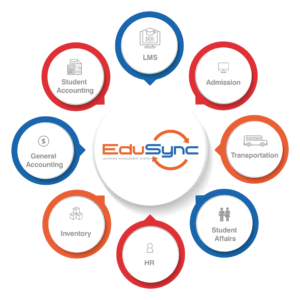
The best school management software doesn’t live in a bubble. It must integrate seamlessly with the LMS for learning data, the Finance module for fee collection, and the HR system for teacher assignments.
Benefits of Using a Student Information System
The implementation of a Student Information System provides a massive Return on Investment (ROI) across the board.
- Improved Data Accuracy: By allowing parents to update their own contact info and teachers to input grades directly, the “middleman” error is eliminated.
- Time-saving Automation: Tasks that once took days, like generating hundreds of report cards, are reduced to seconds.
- Better Decision-making: With real-time dashboards, school leaders can spot trends early, such as a dip in attendance in a specific grade, and act before it becomes a crisis.
- Enhanced Communication: Parents feel more connected when they have 24/7 access to their child’s records, leading to higher satisfaction and retention rates.
- Scalability: As your school grows from 100 to 1,000 students, the SIS provides the digital skeleton that supports that growth without needing to hire an army of new administrative staff.
How Student Information System Improves School Operations
Operational efficiency is the cornerstone of a successful school. An SIS acts as a lubricant for the gears of school life. It streamlines workflows by ensuring that data entered in one place (like an enrollment form) automatically populates other areas (like class lists and fee invoices).
This reduced administrative workload allows staff to shift their focus from “pushing paper” to “student support.” Better coordination between departments, such as Admissions, Finance, and Academics, is achieved because everyone is looking at the same real-time data. This creates a unified front and a highly professional environment that is evident to parents and regulatory bodies alike.
Student Information System vs LMS vs School ERP
In the world of Education ERP, it is vital to understand the hierarchy of systems to make an informed buying decision.
| System | Primary Function | Target User |
| SIS (Student Information System) | Managing student data, records, and registration. | Registrars, Admins, Principals |
| LMS (Learning Management System) | Delivering content, assignments, and online quizzes. | Students, Teachers |
| School ERP (Enterprise Resource Planning) | Full-school operations including Finance, HR, and Inventory. | Owners, CFOs, Managers |
A school ERP system usually contains both a Student Information System and an LMS (or integrates with them) to provide a 360-degree view of the institution. The SIS provides the data foundation that both the LMS and the ERP rely on to function correctly.
Role of Student Information System in Digital Transformation
Digital transformation in education is often misunderstood as merely placing tablets in the hands of students or using smartboards in classrooms. In reality, true transformation is rooted in a data-driven education culture, where the Student Information System serves as the foundational architecture. A Student Information System acts as the “central nervous system” of a digital school, converting raw, disjointed data into a cohesive digital narrative. By digitizing every touchpoint, from the initial inquiry and biometric attendance to behavioral notes and final transcripts, the SIS eliminates the “information lag” that plagues traditional institutions.
This digital evolution enables schools to transition from being reactive to proactive. For example, instead of waiting for a mid-term crisis to realize a student is struggling, a digitally transformed school uses its SIS to flag early warning signs across multiple indicators simultaneously. This level of automation of processes allows the institution to operate with a level of agility previously reserved for tech startups. Furthermore, it empowers leaders with smart decision-making tools; when every department, from the registrar to the classroom teacher, is contributing to and drawing from a single digital truth, the school can implement personalized learning paths and adaptive administrative strategies that meet the unique needs of every student in real-time.
Common Mistakes Schools Make Without SIS
In the absence of a professional Student Information System, many schools fall into the trap of “manual workarounds,” which creates a fragile and inefficient operational environment. One of the most pervasive mistakes is relying on spreadsheets like Excel or Google Sheets to manage student records. While these tools are excellent for basic calculations, they are not relational databases. They lack the security, audit trails, and multi-user synchronization required for school management, often leading to duplicate entries, version control nightmares, and, most dangerously, significant data breaches.
Another critical error is the lack of integration between existing tools. Schools often use one app for attendance, another for grading, and a third for fee collection. Without an integrated SIS system, staff spend an exorbitant amount of time, sometimes up to 40% of their work week, manually moving data between these disconnected “silos.” This fragmented approach results in poor data management, where a student’s address might be updated in the finance office but remains incorrect in the emergency contact list held by the teacher. Furthermore, without a centralized reporting system, school owners are left “flying blind,” making expensive institutional decisions based on anecdotal evidence or outdated paper reports rather than verified, real-time analytics.
How to Choose the Best Student Information System
Selecting the right school management software is a high-stakes decision that affects every stakeholder, from the IT department to the parents at home. The first criterion must always be Ease of Use; if the interface is cluttered or counter-intuitive, teacher adoption will fail, and the data in the system will quickly become obsolete. A high-quality SIS should feel like a modern consumer app, fast, responsive, and easy to navigate. Secondly, Customization is non-negotiable. Every region has different regulatory reporting requirements, and every school has its own unique grading scales or house systems. The software must be flexible enough to mirror your school’s specific workflows rather than forcing you to change your educational philosophy to fit the software.
Furthermore, Security and Compliance must be vetted rigorously. In an age of increasing cyber threats, your chosen SIS must offer robust data encryption, multi-factor authentication, and role-based access control to ensure that sensitive student data is only visible to authorized personnel. You should also evaluate the system’s Integration Capabilities; a top-tier SIS should serve as the core of an Education ERP, connecting seamlessly with your Finance, HR, and LMS modules. Finally, never overlook the importance of Local Support. Technology will inevitably face hiccups; having a partner that provides on-site training, a local help desk, and a deep understanding of the regional educational landscape is what separates a mere “vendor” from a long-term strategic partner.
Student Information System in Syncology
At Syncology, we provide a world-class, integrated school ERP system where the SIS is a flagship core module. We understand that a school’s data is its most valuable asset, and our system is designed to protect and leverage that data.
Why Syncology’s Student Information System stands out:
- Comprehensive Data Hub: From the first “lead” in admissions to alumni status, every data point is captured.
- Seamless Registration: Our Student Information System handles the entire digital admission process, including document uploads and fee payments.
- Native Integration: Because our system is built on a robust Odoo-based framework, your SIS data talks directly to your HR, Finance, and LMS modules. There are no “gaps” in your data.
- Flexibility: We offer the full Education ERP suite, but our modular approach allows you to start with the SIS and scale as your institution grows.
Syncology empowers schools in the Saudi and regional markets to reach global standards of excellence through technology that is powerful yet simple to manage.
Future of Student Information Systems
The horizon for the Student Information System is moving toward a state of “Hyper-Intelligence.” We are rapidly moving past the era of record-keeping and into the era of AI-powered analytics. In the very near future, an SIS won’t just tell you a student’s current grade; it will provide predictive insights, utilizing machine learning to forecast a student’s future performance or identifying their likelihood of social-emotional struggles before they manifest. This allows for a level of “precision education” that was previously impossible.
We are also seeing the emergence of Smart Automation, where the SIS manages the “logistics of learning” autonomously, such as automatically adjusting a student’s schedule based on their real-time mastery of a subject or re-routing school buses based on daily attendance data. As we move toward Fully Digital Campuses, the SIS will likely integrate with “Internet of Things” (IoT) devices to manage campus security, climate control in classrooms, and even automated library check-outs. Finally, the integration of Blockchain technology will revolutionize how we handle credentials, providing students with permanent, tamper-proof, and universally verifiable digital transcripts that they can carry with them for life. The SIS of the future will not just be a database; it will be an invisible, intelligent assistant that ensures the school runs at peak efficiency while educators focus entirely on the human element of teaching.
Conclusion
A Student Information System is no longer just an administrative tool; it is an essential pillar for any modern school’s success. It improves efficiency, ensures data accuracy, and provides the backbone for true digital transformation. By moving away from manual, fragmented processes and embracing an integrated ERP for Schools, institutions can ensure they are ready for the challenges of the future.
Integrated systems like Syncology represent the future of education management, where technology and pedagogy meet to create the best possible outcomes for students.
Are you ready to revolutionize your school’s data management?

Request a Demo
And discover how our integrated Student Information System can upgrade your operations and support your journey toward a smarter, digital campus. Contact us now to consult with our education technology experts.