
The Future of Education in Egypt is witnessing a new era of accelerated transformation, driven by a genuine desire for development and the restructuring of the academic and administrative system to keep pace with international standards. Technological advancement within educational institutions is no longer just a supporting tool or a cosmetic addition; rather, it has become the backbone of the entire operational process. This digital movement is fully aligned with Egypt’s comprehensive and sustainable digital transformation vision, which aims to build an integrated digital society that places education quality at the forefront of its priorities to graduate generations capable of competing in the modern labor market.
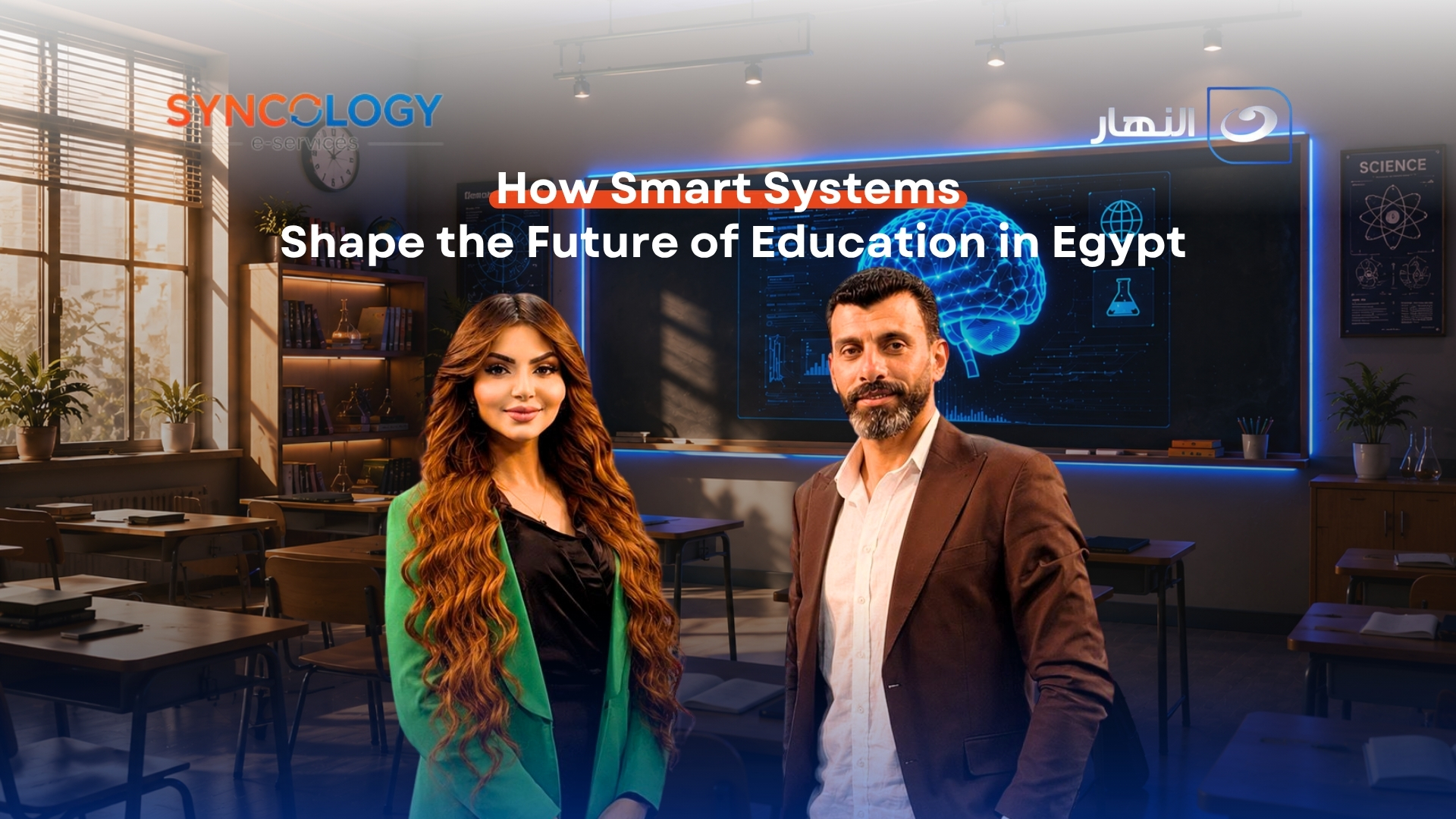
In this context, a special interview with Engineer Islam Sami, technology expert and founder of Syncology, was broadcast on Al-Nahar TV on the program “Benfakar Fi Bokra” (Thinking About Tomorrow) with media presenter Rania Al-Sahar. The interview cast a sharp spotlight on the way artificial intelligence and cloud-based systems are reshaping the ecosystem. This meeting provided a clear strategic vision that deeply explains how these technologies shape the Future of Education in Egypt, emphasizing that digitalization and the elimination of complex paper transactions are no longer a luxury that can be postponed, but rather an absolute necessity to ensure the continuity and growth of any educational institution aspiring to remain at the forefront of the academic scene.
How is the Future of Education in Egypt Taking Shape?
Speaking about the Future of Education in Egypt forces us to perform a conscious reading of the variables surrounding the local and regional educational environment, where government will intersects with technical innovations to produce a new generation of advanced schools that draw the primary features of the Future of Education in Egypt.
The Egyptian State’s Vision for Digital Transformation in Education
The Egyptian state is exerting massive and systematic efforts to implement its digital transformation strategy. This vision directly aims to formulate the Future of Education in Egypt and is not limited merely to delivering tablet devices to students or digitizing curricula. Rather, it extends to include developing the technological infrastructure of schools, providing e-learning platforms, and transforming educational administrations into smart systems capable of reading data accurately and using it to continuously improve the quality of educational outcomes, thereby ensuring the leadership of the Future of Education in Egypt.
Requirements of the Modern School
The modern school in 2026 is no longer capable of operating with old mechanisms if it wishes to align with the Future of Education in Egypt. High student density, the massive volume of data generated daily, and the diversity of tuition and fees are all factors that demand highly precise operational standards. Schools today need a seamless flow of information across all their departments, and the ability to manage their human, financial, and logistical resources through a single screen that guarantees transparency and speed as a core pillar upon which the Future of Education in Egypt stands.
The Role of Technology in Raising the Efficiency of the Future of Education in Egypt Institutions
Technology plays the role of the organizer and accelerator for all processes within the school to match the aspirations of the Future of Education in Egypt. By replacing traditional ledgers with software systems, schools can save thousands of hours wasted on routine work and redirect the efforts of the administrative and teaching staff toward focusing on student care and skill development. This raises the operational efficiency of the institution by unprecedented rates and roots innovation into the Future of Education in Egypt.
How Do School Management Systems Contribute to Improving Performance?
Conscious and organized administration is the cornerstone for the success of any institution looking toward the Future of Education in Egypt. When this administration transforms into a smart digital model, a qualitative leap appears in all the performance indicators of the institution.
Challenges of Traditional Management
Schools that still rely on traditional methods distance themselves completely from the path of the Future of Education in Egypt and face recurring, complex crises. Stacked paper files are always vulnerable to damage or loss, manual archiving processes take a long time, and catastrophic errors occur in tuition calculations and employee salaries. Added to this is the absence of real-time vision for leadership, as the school principal is forced to wait days or weeks to obtain a comprehensive financial or academic report, leading to decisions based on guesswork that do not fit the requirements of the Future of Education in Egypt.
Benefits of an Electronic School Management System
When an institution adopts an electronic school management system, it immediately rids itself of these operational obstacles and takes its first real steps into the Future of Education in Egypt, achieving strategic benefits that include:
- Speed of Decision-Making: Real-time reports and analytics are available at the click of a single button, allowing the administration to intervene quickly to treat any financial or academic problem as soon as it occurs.
- Reduction of Human Errors: Manual accounting errors in student invoices or payroll sheets completely disappear thanks to the full automation of financial processes.
- Improving the Parents’ Experience: The parent receives instant and direct follow-ups regarding everything related to their child—including grades, attendance, absence, behavior, and outstanding fees—via dedicated electronic portals that translate the quality of the Future of Education in Egypt.
- Raising the Efficiency of Operational Processes: Reception, accounts, student affairs, and inventory employees are interconnected in a unified network that eliminates redundancy and accelerates daily transactions.
How Does Syncology Support the Digital Transformation of Schools?
Syncology is one of the leading companies that has taken it upon itself to provide real technological solutions specially designed to suit the nature of the local educational market, moving beyond traditional ideas of simple software toward building smart systems that establish the Future of Education in Egypt.
The Company’s Vision Aligned with the State’s Vision
Syncology’s vision matches the strategic directions of the Egyptian state completely. The company believes that driving the wheel of digital transformation for schools is the inevitable mandatory path to building the Future of Education in Egypt. Therefore, the company does not seek to sell separate programs, but rather works as a technological partner that analyzes the school’s reality and sets a clear plan to transfer it completely into the era of the smart school that serves the Future of Education in Egypt.
Building an Interconnected Educational System
Syncology’s development philosophy is characterized by its ability to end isolated data islands inside the school. The system links the administration, teacher, student, and parent in a continuous dynamic communication loop, which ensures the flow of information without the slightest obstacles in line with the standards of the Future of Education in Egypt.
Focus on Efficiency and Sustainability
The company’s software solutions seek to achieve financial and operational sustainability for schools by reducing resource waste (whether material resources like paper and printouts, or human resources through organizing work hours). This ensures that the educational institution lowers operational costs and increases profitability and capacity to participate strongly in shaping the Future of Education in Egypt over the long term.
The EduSync System and Its Role in Developing Schools
At the heart of the innovative solutions offered by Syncology, the EduSync school management system stands out as an integrated, cloud-based school ERP system designed to manage all aspects of school life with absolute efficiency and complete safety to pave the way toward the Future of Education in Egypt.
EduSync is not just a program for recording absences or monitoring grades; it is a comprehensive digital environment that intelligently organizes the documentary, financial, and academic cycle of the school. This gives the administration complete control and 100% clear vision over everything that happens within the walls of the school campus, representing a qualitative leap that supports the Future of Education in Egypt.
The 8 Modules That Manage the Modern School
The EduSync system derives its exceptional power from its smart engineering division into 8 integrated modules (software units) that support the pillars of the Future of Education in Egypt, each covering a vital aspect of school operations:
1. Admissions and Registration Management
This module organizes the entire school application process digitally from start to acceptance as part of the tools for the Future of Education in Egypt. Parents can upload the required documents online, and the system schedules evaluation interviews and distributes students to waiting lists based on pre-defined school criteria, completely ending application queues and overcrowding during admission seasons.
2. Student Affairs
This is the comprehensive digital repository for every student in the school, containing personal, medical, and academic data, as well as attendance and behavioral records. This module allows the extraction of certificates, official reports, and class lists in moments, and facilitates tracking the student’s academic movement across different school years to serve the goals of the Future of Education in Egypt.
3. General Accounting
This module represents the throbbing financial heart of the system. It is a professional financial and accounting school ERP system that allows the management of the chart of accounts, cost centers, and daily entries, as well as extracting the trial balance and final financial reports with absolute accuracy. This ensures that senior administrations and owners monitor profits and expenses with extreme precision that supports the stability of the educational ecosystem.
4. Student Accounting
This module specializes in managing and tracking all tuition fees, books, school uniforms, and transportation. The system generates invoices automatically, applies sibling discounts or scholarships, and distributes and schedules installments, while sending automated reminders to parents about due payments and providing multiple fast electronic payment options that suit the digital age and educational regulations.
5. Human Resources and Payroll
This section manages everything related to the school’s staff of teachers, administrators, and workers, linking attendance, departure, absence, and vacations automatically with payroll lines. The module calculates allowances, insurance, and taxes, saving days of hard manual work for the accounting and human resources department at the end of each month to drive work efficiency in education.
6. Inventory and Purchasing
This module ensures live and accurate monitoring of all school assets and consumables, from textbooks, furniture, and laboratory tools to technical devices. The system issues automatic alerts when the stock of a particular item approaches depletion, and manages the purchasing cycle, price quotations, and suppliers with high efficiency that prevents financial waste and preserves institutional resources.
7. School Transportation Management
A smart module dedicated to organizing the movement of school buses. It allows the distribution of students to routes, supervisors, and drivers accurately, and helps in tracking paths and operational expenses for each bus, which ensures the highest levels of safety and comfort for students and provides peace of mind to parents, the provision of which is a primary goal in institutions.
8. Integration with the Learning Management System (LMS)
The administrative ERP system from EduSync links directly and seamlessly with the e-learning LMS, creating a unified environment that integrates attendance data and administrative grades with assignments, electronic exams, and interactive educational content uploaded by teachers, to truly be the integrated model of what digitalization should be to achieve the ambitions of the Future of Education in Egypt.
Artificial Intelligence is a Partner to the Teacher, Not a Substitute
During the television interview on the program “Benfakar Fi Bokra” on Al-Nahar TV, Engineer Islam Sami emphasized a fundamental and pivotal point that removed many common fears regarding the dimensions of technology in the Future of Education in Egypt: Artificial intelligence in education never comes to be a substitute for the human teacher, but is rather the most powerful tool to empower and assist them.
Why Does the Teacher Remain the Most Important Element?
Education is, at its core, a human process based on guidance, character building, instilling values, and providing psychological and educational support to students. These are purely human skills that no artificial intelligence algorithm, no matter how precise, can simulate or replace. The teacher will always remain the primary driver and true leader inside the classroom that builds the Future of Education in Egypt.
How Does Artificial Intelligence Help the Teacher?
Artificial intelligence transforms into a smart personal assistant working around the clock to serve the teacher and keep pace with the leaps of the Future of Education in Egypt, appearing in multiple aspects:
- Saving Time: The system handles the automation of routine processes such as recording attendance and absence, giving the teacher extra time to focus on explanation and direct interaction with students.
- Preparing Exams: Smart tools help the teacher generate diverse exam questions with graded difficulty based on curriculum objectives and overall student performance levels to develop measurement tools in institutions.
- Smart Analytics and Performance Tracking: The system analyzes student grades and behavior continuously, issuing smart reports that alert the teacher to the presence of a student or a group of students facing difficulty in grasping a specific concept. This allows for early intervention and providing appropriate support to serve the goals of education in Egypt.
The Role of Artificial Intelligence in Supporting Students
For the student, artificial intelligence represents a personalized guide and educational assistant that reshapes the pillars of learning in Egypt. It provides them with flexible learning paths that fit their own speed of comprehension and offers them immediate feedback when solving homework and tests, which increases their motivation to learn and significantly improves educational outcomes.
The Smart School is the Future of Education in Egypt
The concept of the smart school is the essential component and the actual engine that will draw the features of the Future of Education in Egypt during the coming years. It is a concept that goes beyond the mere use of technology to its full integration into institutional culture to enhance the leadership and competitiveness of the future of education.
Integration Between ERP and LMS
True power appears when the financial and administrative school management program integrates with the learning management system (LMS) to manufacture the features of the Future of Education in Egypt. This interconnection allows senior administration to see the full picture, where a student’s attendance rate and academic level can be linked to their behavioral and financial status, producing a unified and deep database that serves all parties of the educational process and supports the progress of the Future of Education in Egypt.
Data-Driven Decision-Making
In the smart school system, the eras of guesswork end and the Future of Education in Egypt flourishes. Every decision made by the school’s board of directors—whether related to adjusting fees, opening new classes, updating curricula, or evaluating teacher performance—is based on numbers, statistics, and accurate reports updated moment by moment generated by the smart system to serve the evolution of the future of education.
Improving the Student and Parent Experience
The smart system achieves one of the most important aspirations of the Future of Education in Egypt, as communication between school and home transforms into a seamless and sophisticated experience. There is no need to wait for traditional periodic meetings to know the child’s level; rather, the parent can know all the details through their own application and reach the administration and teachers with complete flexibility, enhancing mutual trust and ensuring student retention for long years.
Raising Operational Efficiency and Lowering Costs
School automation through the EduSync system helps lower operational expenses directly to provide a sustainable structure that serves the future of education. Reliance on printouts and papers recedes to the minimum, and the movement of buses, inventory, and purchasing is tightly controlled to prevent any manipulation or waste. This raises the school’s profitability and allows it to direct financial surpluses to develop its facilities and laboratories to match the aspirations of educational institutions.
Why Has Digital Transformation Become a Necessity for Every School?
Schools no longer have a choice but to move forward on the path of comprehensive digital transformation, as the surrounding environment forces this change strongly:
- Increased Competition: Schools that adopt smart systems such as the school management system in Egypt offer distinguished services that attract parents and place them in a strong competitive position compared to traditional schools.
- High Expectations of Parents: Parents today live in the era of instant smart services and expect the school to provide the same level of speed and technological development in the circulation of information and payments.
- Speed of Access to Information: In contemporary administrative environments, the delay of information for several days is considered an operational loss; therefore, the cloud guarantees the administration access to any financial or academic data from anywhere and at any time.
- The Need for Data-Driven Decisions: Successive economic and academic changes require complete flexibility and administrative maneuvering capacity, which cannot be achieved without possessing a strong and smart school ERP system that owners and managers rely on.
Conclusion
Reading the details of the current scene clearly confirms that the Future of Education in Egypt depends fundamentally and essentially on achieving a smart and balanced integration between the creative human element and advanced technology. As Engineer Islam Sami explained in his rich television interview with media presenter Rania Al-Sahar on the program “Benfakar Fi Bokra” on Al-Nahar TV, the teacher will always remain the axis and the beating heart of the educational process, while artificial intelligence and smart systems come as tools for empowerment and manufacturing efficiency, not substitutes that eliminate the human role.
Schools and educational institutions that take the initiative and invest in electronic school management and adopt integrated solutions like the EduSync system from Syncology today are the ones that will be the most distinguished, capable of competing, and achieving sustainability tomorrow, thereby contributing to building the educational digital renaissance.